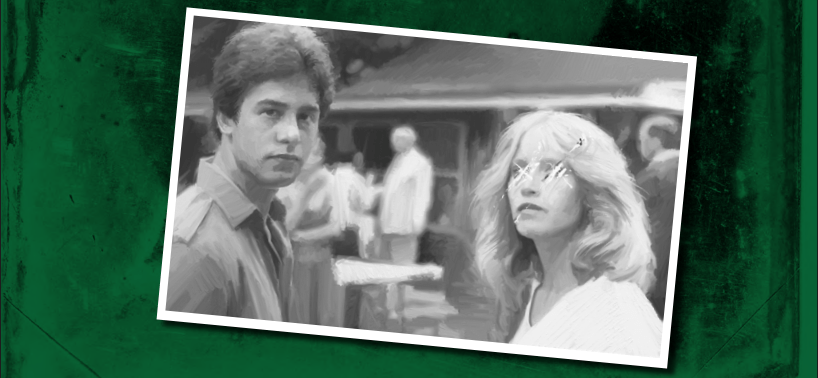
(Header image from the Need to Know quickstart for Delta Green, written by Shane Ivey and Bret Kramer, with art by Dennis Detwiller)
You hear sirens in the distance as you see the flames continue to rage, pushing towards you. The truck has flipped from the explosion and is completely crushed. The few bits of Kuntz that are still intact lay motionless on the ground. What do you do?
Yep, that’s me, watching my players try to weasel out of maybe the worst situation I have ever seen a party in. Over a few short seconds everything went to shit. One PC was full dead, the remaining three characters were all 1 hp away from being unconscious. All of the careful bureaucracy that took place over the last four real life hours was unraveling like Rivers Cuomo’s sweater. It was not just bad, it was electrifying. Pure drama.
How did we get here you may be asking? Well, let’s start from the beginning.
Delta Green is a very fun game in a way that scratches an itch that cannot be scratched by playing “trad” heroic fantasy games. (If you want to argue over the definition of trad, post your essay in the comments and I will get back to you in 6-8 weeks.) You are playing as modern day people with modern day abilities and modern day problems. These characters might be just like you or me, except that they are occasionally called upon to investigate and eradicate or appropriate unnatural beings and deeply distressing powers.
SPOILER CORNER
The following is a list of possible scenes you might experience in Delta Green:
- Agents sitting around a dead man’s apartment, flipping through years of tax documents looking for any out of place payments, while one agent makes a chicken pot pie they found in the freezer.
- An agent sitting on a couch in a isolated cabin, carefully removing the tape from a slightly melted VHS and adding it into a mint condition copy of the 2002 family feature film Lilo & Stitch.
- Three agents realizing all at once that a former Delta Green agent tried to bring his wife back to life, succeeded in a gruesome and horrifying manner, then trapped her inside a septic tank that is only 30 yards away from them right now.
- The anthropologist (why did we bring an anthropologist again?) decided to back an F-150 directly into a burning septic tank, (re-)killing the undead wife, the Delta Green computer scientist, and any hopes of keeping this mission low profile.
If it wasn’t clear, in addition to being illustrative examples of potential scenes, that was actual order of events in my session of the module Last Things Last. This was maybe the most fun TTRPG session I have had in recent memory.
Why was it so good?
I think the two biggest benefits to the system are its deep-seated juxtaposition and the power of just being a person.
Horror just doesn’t work if the elements of the horror are commonplace. A single, well-placed jump scare will get viewers every time, but if that is the beginning of every scene, the audience is lost. You need to lure the audience (in this case, your players) into a false sense of security. Few things do that better than making them do paperwork.
Nothing interesting happens when you are reviewing payroll documents, horrifying or otherwise. It is just loud sighs and the rustling of dot matrix paper. Then BAM, you hit them with something disturbing just when they let their guard down. Everything is going according to plan until they find a shed filled with 20 single gallon gas cans.
Your players want to be afraid and bureaucracy is Delta Green’s main tool to make sure that happens.
If you are coming from the heroic high fantasy scene like I am, you may have had the very normal experience of trying to run horror in those systems and watching it fall flat as your half-spider, half-clown Halloween monster just gets bullied by your players.
The problem is that in those games your players have magic swords and fireballs. What is there to be scared of? In a game that is centered around combat, with these supernaturally powerful player characters, making a challenge truly frightening is extremely difficult because the solution is probably to just hit it until it dies.
In Delta Green, no one has a special axe or mystic armor. You are just a person. There is a high chance you have never even used a gun. You are always one hit away from death, and that makes any sense of danger real. Getting into combat is a probably a mistake. If you have any serious sense of self preservation, this game will make you afraid. That’s what makes it good.
Was it hard to prep?
No. I have been running pre-written games for a few years now, and the majority of modules include a lot of boxes, lists, and tables to make for easy reference. Ironically, despite the dry, bureaucratic themes of the game, that was not the case for this adventure. The scenes are mainly painted through narrative paragraphs and images, which I love!
It is slightly harder to reference in play when you don’t have the box outs and tables, but it tells a story instead of just showing me a map. The narrative sticks in my mind better, and I can just highlight the important items as I prep. The text gives me the vibes over details.
It’s fun to read and easy to run. A perfect combination for GM prep.
Is that it?
For now! It is 1 AM and I am falling asleep between each sentence I type, so I have to wrap for now, but there will be more Delta Green content soon. I just ran the session 0 for my Impossible Landscapes game, and that is sure to be an absolute banger. I will report back once the minds of my players are sufficiently broken.
I should be better equipped to discuss the actual mechanics of the game after Impossible Landscapes, but I will give a quick teaser now. Bonds are amazing in this game. I have seen plenty of games that use them just as grounding for the characters, and games that use them mechanically, but the bonds in Delta Green are good because they are mechanical and they always hurt to use. If you are about to take damage to your sanity, you can project your mental trauma onto these bonds, which slowly ruins the relationship, but keep your mind in tact.
Using the relationship with your family as a shield for your sanity is an incredible mechanic and I can’t want to watch as my poor agents ruin their home lives in the service to Delta Green who are almost certainly not the “good guys.”
Acknowledgments
Thank you to the cast of this wonderful game: Raggadorr as the surprisingly helpful astrophysicist, TundraFundra as the extraordinarily cheap anthropologist, Hat! as the competent alphabet agent who escaped to the nearest non-extradition island, and Kyle as the now deceased and very charred computer scientist.
Thank you to Dennis Detwiller, Adam Scott Glancy, and John Scott Tynes for creating Delta Green, and Shane Ivey and Bret Kramer for creating the Need to Know quickstart for the game that I used for this session.
An extra special thank you to the designer of the Secret Sunday Sampler logo kraftpaperhat (Hat! from above), who went above and beyond and created an entire brand kit for the SSS, helping bring more legitimacy to what is a passion project for the many people involved in the one-shot club. Look at the new icon in on your web browser tab now, how fun is that? I am obsessed.
No AI was used to write this blog (because this review was written in 2002 on a Sys Performance 1800+, a modern computer for a modern businessman).
P.S. The combat for this game is a little clunky, which is fine. The game isn’t about that. Also, I am certain that system mastery would speed things along. On the other hand, the skills system sings. I am now a certified percentile dice lover.
P.P.S. Just a few months ago I was completely burnt out on TTRPGs, and had to end the weekly Pathfinder 2e game I had been running for years. Now I am playing more than ever despite working tons of overtime and struggling through grad school. The Secret Sunday Sampler and its stellar members are the main source of that change, they have brought an immense amount of joy into my life.
 Birdmilk's RPG Cafe
Leave a comment