
(Header image is from The Grand Budapest Hotel, a Wes Anderson Film. The connection to Troika will become apparent.)
How do I put this? Troika by Daniel Sell is groundbreaking, surreal, and unhinged. The settings and adventures are topnotch. It is so unique, but I don’t recommend you play it. Well, not using its system at least. I say ditch the rules, run the adventures.
The Good
Troika! has been on my list to play for a very long time. Look at the dragon in this game! Have you ever seen something like this? It is like a magic eye! The longer I look at it, the more I want to look. Is that a staircase in the legs? And human teeth in the hands? Wait, is that a dog head behind the main head?
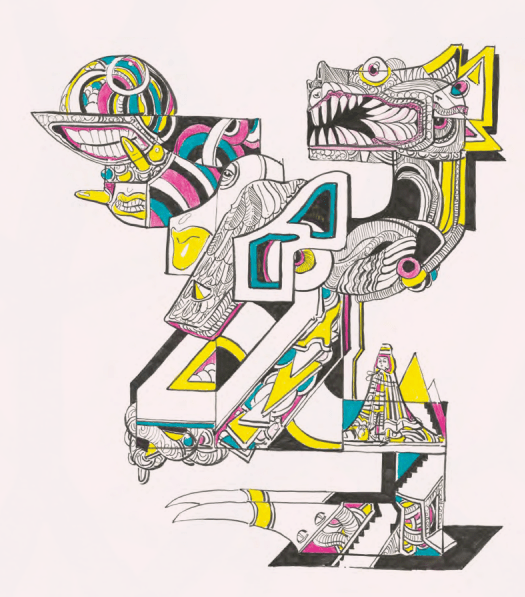
Based off art alone, I have wanted to pull this system out to run a highly surreal, feywilds style spirit world field guide type game, and after playing the game, I am convinced it would nail that aesthetic. Playing this game feels like what the stereotypical Hollywood acid trip looks like. By the end of the game, you’ll be checking that you still have all 10 fingers and that the sun hasn’t melted into the sea.
The worldbuilding in the core book is sparse, but evocative. The important bits of your character are decided by your background. Would you like to be a sentient train man, or a three armed lawful sword lady? Maybe a beefcake bodybuilder or a witch made out of paper? I love every single option.
Sure there are some mundane backgrounds like burglar, but they are made more fun by your wacky companions. In the session I ran, we had three wizard adjacents (a water witch, a friendship mage, and a necromancer) and a porter. The unremarkable bag boy became quite markable in such an unstable and weird world.
The Great
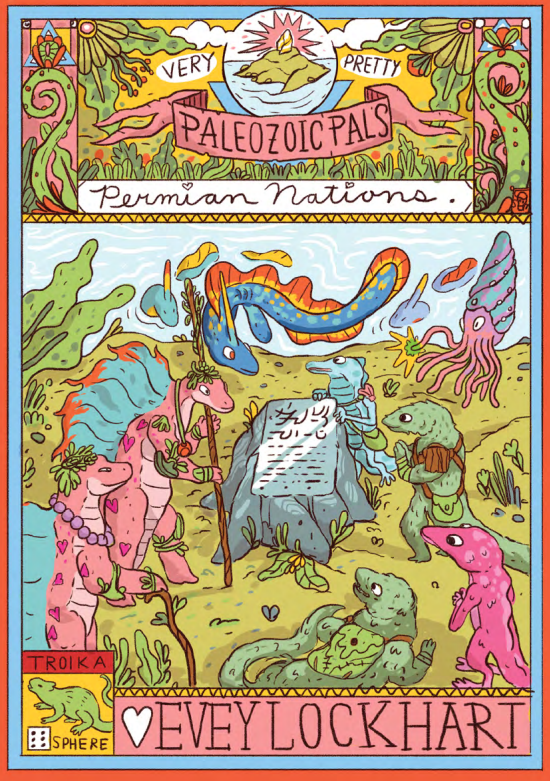
The base core book had me sold, but the splatbooks are what puts this game over the end. Yes, they have their classic (fun!) fantasy tropes: Acid Death Fantasy by Luke Gearing is Dune but Troika-fied, but there is plenty I have never seen. Very Pretty Paleozoic Pals by Evey Lockhart, you get to play as adorable sea dinos that inexplicably coexist with humans. And if you are still not convinced, Daniel Sell’s Get It At Sutlers, lets you get hired at a department store. A DEPARTMENT STORE.
Absolutely genius.
The adventure I ran can be found in the core rule book, titled The Blancmage & Thistle (Spoilers ahead!). It features road weary adventuring party who desperately want to get to their 6th floor hotel room, and the only thing between them and a bath is an elevator. This adventure felt straight out of a Studio Ghibli movie. A clockwork man popping out of the elevator wall to sling its wares, a toxic cloud of gas that also happens to be guest at the hotel, and a tiny living suit of armor.
But the best part? An encounter where a several tigers are stuffed into the lift with the PCs entitled “Too many tigers.” I am sure Daniel was giggling as he wrote, because I was gaggling as I read. After an absolute saga to get to their room, the party is met with a basket of hardboiled eggs and a single bed that is just slightly too small for all of them to fit. The game is absurd in all the best ways.
The Okay
The characters are great, the settings are great, the adventures are great. The stats are interesting. Everything is based on your skill, stamina, and luck. Most of the time you will be trying to roll under your skill stat plus any applicable advanced skill modifiers. Stamina is your health and mana pool, and luck is luck, it depletes as you use it. It’s a clean, intuitive system.
Troika’s big standout mechanics are for combat:
– Initiative is decided by putting chips into a bag, with turns pulled at random
– Every attack is a contested check, winner gets to deal damage
– Damage is dealt based on damage tables for each spell and weapon
Unfortunately, I don’t like any of them. The initiative system is novel, but the very first combat resolved in the character who initiated combat getting passed over as every other combatant took two turns, and then the new round chip was pulled before they got a turn. Not fun for them.
Every attack being a contest check is a cool idea (I have wanted to make it work for a Fire Emblem hack on multiple occasions), theoretically making combat more interesting even when there are way more adversaries than player characters. In practice, being attacked is not thrilling for PCs, they aren’t making decisions, just rolling dice, so it doesn’t make the combat more interesting. It’s also not a fast resolution mechanic, which feels at odds with the very sleek skill system works so well.
Damage tables felt unnecessary. I am sure it is great for being able to fine tune items compared to just changing die sizes or damage modifiers, but again, it just adds extra time looking up damage in a combat system that needs to be quick to really work.
Halfway through the last combat, I gave up on the initiative system and just spotlit players I thought made sense in the moment, and suddenly things began running smoothly. It is a workable system, but not my favorite OSR set of mechanics.
That is the joy of OSR though: I can convert these beautiful books to a system I prefer with little effort. I don’t have to miss out on roleplaying at a department store! I am a huge fan of the art, the adventures, and the setting. The OSR movement has equipped me with the tools to tinker with the parts I think are rough around the edges.
And that is what Hot OSR Summer is all about right?
Acknowledgements
Troika can be purchased here.
Thank you to Daniel Sell for coming up with some of the most grounded but bonkers settings I have ever read, and to Jeremy Duncan, Dirk Detweiler Leicthy, Sam Mameli, Andrew Walter, and Shuyi Zhang for making art that makes me feel some kind of unexplainable.
A big thank you to my players: wyversary as our wizard college student who solved big problems with their wizard biscuits, Zadig our trust luggage porter, Ikea as our necromancer who fully died (then got better), and Raggadorr as the witch that caused Ikea’s death.
P.S. Troika is based on a series of solo RPGS called Fighting Fantasy. Some may say that it is not in fact an OSR game. I say that I don’t care to quibble over definitions and it looks and smells like an OSR game to me. If I was trying to give someone a reference point for the type of game Troika! is, OSR is a pretty clear starting point.
P.P.S. At some point the publishes, Melsonian Arts Council, decided to release all the Troika! rules for free. Very cool. Unfortunately, all of the links to those free resources are gone or broken, and I haven’t been able to determine why. Very strange. I don’t fault them for wanting to make some money in a historically cash sparse field, I just am curious what changed.
 Birdmilk's RPG Cafe
Leave a comment