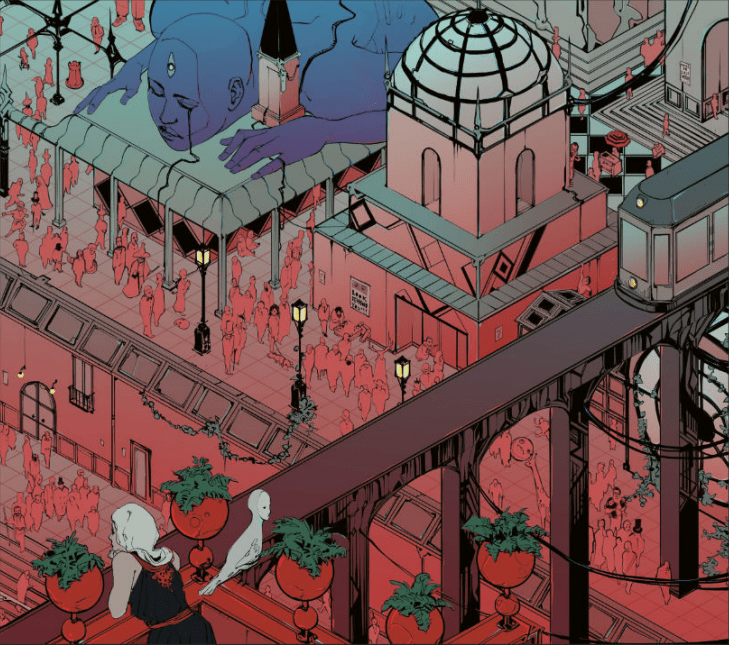
(Header image is the enchantingly beautiful cover art of Electric Bastionland, illustrated by Alec Sorensen)
The cover art shown above played a significant part in my departure from DND 5e, and the subsequent luminous adventure into the world of amazing rpgs that exist outside the Wizard’s gravitational pull.
I don’t remember the first time I saw Electric Bastionland, but I do remember pulling up the store page on dozens of occasions afterward. That cover art sparked something in me. I just knew the stories this game would generate would be far different from anything I was then experiencing at the heroic fantasy fight simulator table, but I was afraid of how hard it might be to learn and teach a new roleplaying game.
To spoil the ending, I was right, well half right. Chris McDowall is a designer of unparalleled quality, and you may as well just buy anything he puts out. But there was no reason for me to fear. There are few fully fledged roleplaying games that are easier to learn, teach, and run than Electric Bastionland. Before I get into the game itself, I want to point to “The Last Word” at the end of the book, a final note from McDowall which genuinely brought a tear to my eye. A portion is reproduced below:
Electric Bastionland was written to be a roleplaying game that anybody could play. … Everyone is welcome in Bastionland, as long as we commit to welcoming each other. … The first principle of Bastion is “Everything is Here”, but that can be read as “Everyone is Here”.
Bastionland isn’t a utopia. It has dark, horrific elements, but your table should be a warm, welcoming place. My goal is to break the barriers that stop us having fun at the table. Nobody should be rebuilding those barriers or creating new ones. Anybody bringing hatred, prejudice, or elitism to the table is working against the intent of this game.
Thank you and have fun,
Chris
(The text in full can be found in the full Electric Bastionland and the very generous and fully functional free edition)
This message was branded into my mind. A pure and honest plea to end the gatekeeping and in-group out-group thinking I have seen and continue see across so many spaces in this niche hobby. Let’s all be a little kinder to one another. Everyone is Here.
On to the review….
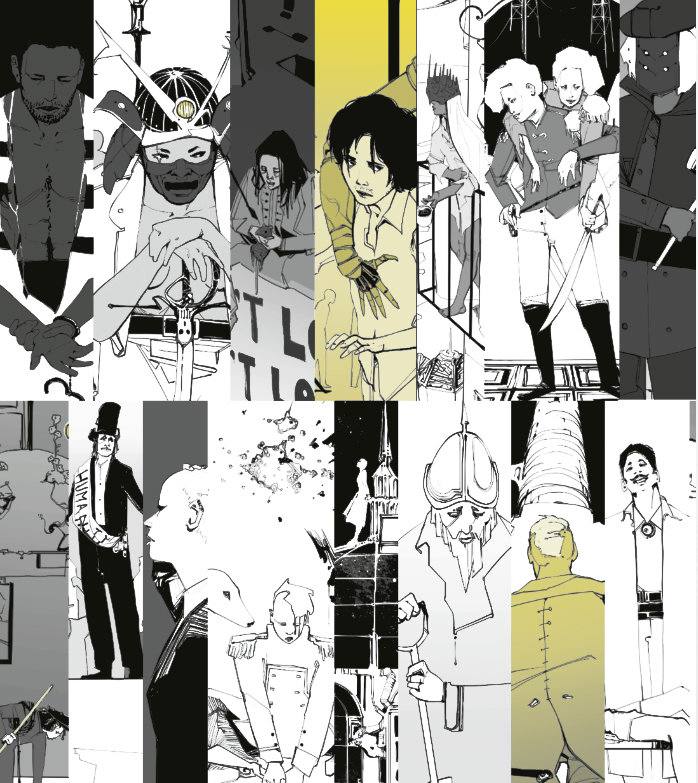
(The art in this book is incredible. The intentional and very sparse use of yellow across black and white is so damn effective.)
While this a wholly stand alone game, it uses a lot of the same basic mechanics as Into the Odd which I have already reviewed here. Everything I loved then shows up here with a few fantastic additions, the biggest being failed careers.
While Into the Odd may be the mechanical system for Electric Bastionland, I would argue that the main game exists almost completely in these failed careers. They cram so much information into a few paragraphs, a couple of tables, and a beautiful piece of art.
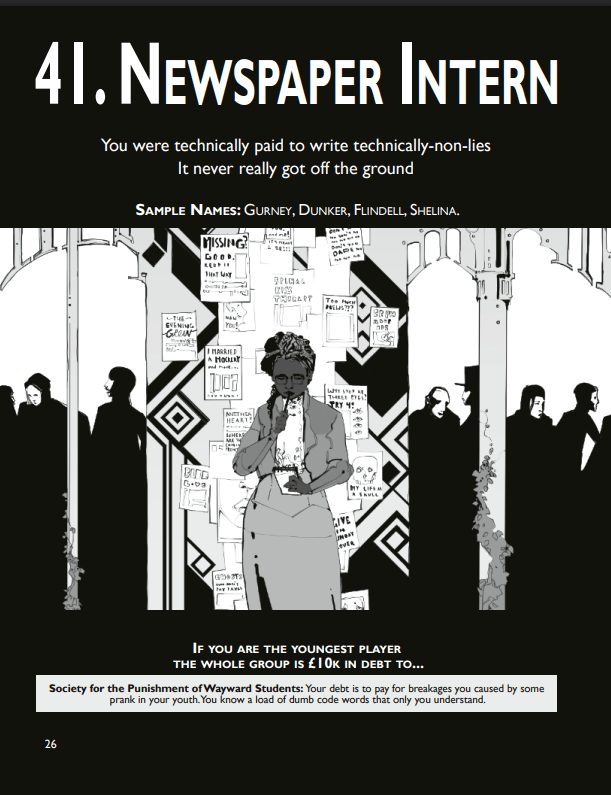
(From the free edition of Electric Bastionland)
Each failed career determines your equipment and a few special powers or skills, but most importantly they bestow on your party a canon event. You are all traveling together for a reason: crushing debt. You all owe an absurd amount of money to 1 of 100 uniquely interesting and uniquely horrid usurers. Right off the bat your party is guaranteed to have a shared goal, a shared history, and likely a shared hatred, a common enemy. It’s effective.
Okay, so maybe crushing debt in a broken society is hitting a little too close to home, but remember, this is still a fantasy game! Unlike in real life, you may actually pay off this debt. That’s real catharsis. Plus the debtors in-game want you to succeed so they provide some support (of dubious quality).
Layout
This game blew my mind when I opened it for the first time. The failed careers make up a majority of the game both metaphorically, but also physically. There are about 15 pages of game rules then 200 pages of failed careers. Two. Hundred. Each one has the same format, the beautiful art shown above, and then the associated tables, shown below.
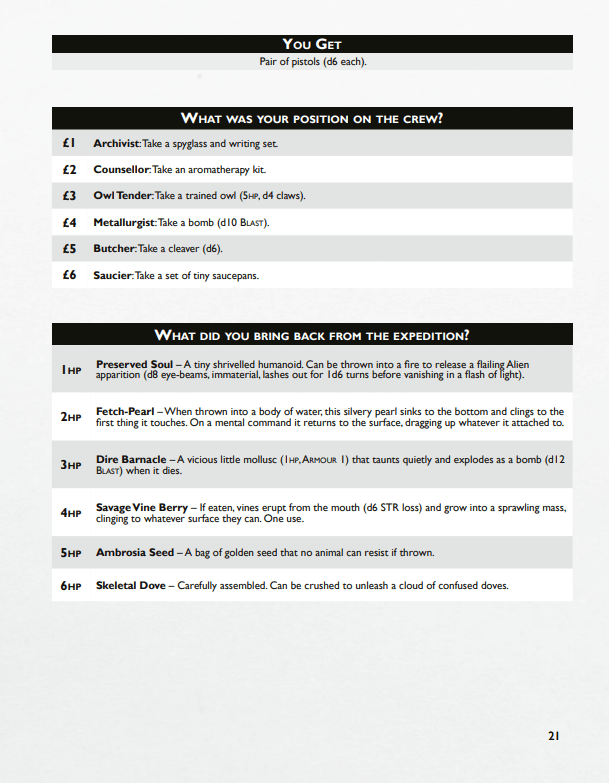
The amount of whitespace felt illegal when I first flipped through the book. Aren’t rpg books for stuffing as many rules as possible into as many 2 column pages as you can crowdfund? But McDowall is efficient. Each spread is a microcosm of the ethos of the entire game.
Your character is not a sheet, your character is the choices. The game is not what is on the page, the game is what happens at the table. You get exactly what you need to play the game and not a word more.
Rivals
The night before I ran this game for DragonCon, I had an incredible idea to really make the adventure pop: a rival party. What better way to put the heat on pillaging an ancient electropunk library than to have a haughty set of experienced looters show up on scene? I felt like a genius, I was so excited to tell everyone in the OSR server–
What’s that? ….. It’s in the book already? That’s just part of the game? Fuuuu…..

Of course. Well, points to me for having the same idea as the designer I guess (Though one demerit for missing it on my first read)1. This is an amazing rule. Treasure hunting is dangerous and your players have every reason to be cautious and careful, but where is the fun in that? Debt is what gets them into the holes in the ground, but rivals are what makes them take risks once they are down there.
Pain point (Singular)
I only had a single issue with this game: shared combat rolls. Similar to Into the Odd, there are only damage rolls, no attack rolls. The major difference is that if multiple PCs are attacking the same target, they all roll, then only the highest result is taken. I think for math reasons this is probably a good way to do it, and theoretically this should incentivize players to do more interesting things in combat than just attack. In practice my players just wanted to attack the robot librarian, and the frustration was palpable as they watched someone else roll max damage, guaranteeing their roll would be meaningless.
This system gets further refined in Mythic Bastionland, where lower rolls can be used for cool combat maneuvers and gambits, but without those additional options, it bummed my players out. I ended up just using Into the Odd rules where each combat action is resolved separately. Overall more deadly, but more satisfying for a one shot.
But that was my only complaint, and it took thirty seconds to correct to my preferred playstyle. This is what I love about OSR games in general, but especially McDowall’s games. The core principles are so clear that I can make a change in the design to better fit my table on the fly without having to unravel a web of hundreds of pages of potential rules interactions I may be stomping on with any given ruling.
Should you buy it?
Yes! Obviously! Right now! Did you not see the art? Go back and look at the art! Unfortunately the physical book is sold out at the time of writing, but I believe there is another print on the way. This is one book that I think you should own in print even if you usually use pdfs. It is just that beautiful. Until then you can buy the pdf on itch.io today or check out the previously mentioned free edition.
Acknowledgements
Thank you to Chris McDowall for making my favorite games. Mythic Bastionland is in my queue for a full campaign and I am waiting very (im)patiently for Galactic Bastionland, whenever that rolls around, and I just got the sci-fi skirmish game MAC ATTACK which I am itching to play. McDowall also hosts one of my favorite podcasts where he talks with other great designers and discusses three games that are important to them. Another season just began after a long hiatus, you can find it here.
For this review, I ran a delightful little adventure by Cairn designer Yochai Gal called the Positronic Library, which can be found here. You want to be a robotic shusher that blasts players if they don’t keep quiet? You got it. Thanks to Gal for writing such a fantastic work. He also happens to co-host one of my other favorite podcasts, Between Two Cairns where he and Brad Kerr (and often Sam Mameli) review OSR modules, talk about etymology, and play the coolest podcast bumpers this side of the Atlantic. Find it here.
Thank you to TundraFundra for letting me stay at his house for DragonCon, giving me the courage to run games at a con for the first time, and playing in said games. It was a blast.
A continued thanks to kraftpaperhat for making the Secret Sunday Sampler branding, though you may have noticed that the blog looks considerably different! My reviews have started to expand beyond just those games I play on Sunday with my wonderful SSS friends, and I (selfishly) wanted to connect the blog to whatever shred of online presence I have. If you google “birdmilk’s blog” it’s now on the second page of search results, which is much higher than when it was called the Secret Sunday Sampler. Slowly we will get some name recognition.
Finally, thanks to everyone who reads these reviews. It brings a special sort of glee to look at my monthly metrics and see that people actually look at the stuff I write.
P.S. My hot OSR summer (HOSRS) should be at a close, we are well into fall, but I don’t know if I can give it up. I started this experiment to give OSR games a shot without any real expectation of liking them, but I think they might be my favorite genre of game. For years playing DnD5e, then later Pathfinder 2e, I chased after those moments where players would interact with the terrain in a unique way or find a random item on their character sheet from 10 sessions ago that would totally shift an encounter. In those games, those moments were rare, and in many cases the rules actively worked against them.
In OSR, those moments are almost a requirement. Every single session a player has blown my mind with their creativity, and it never, ever feels like they are cheating or breaking the rules. The character sheet isn’t a limiting factor, it is an idea generator.
P.P.S. That last post script doesn’t mean I don’t like crunchier games. I recently started up a game of Starfinder 2e and it has been a blast. That said, after my time in the OSR mines, I approach the game differently. Dungeons are no longer a collections of fights, but a serious of challenges where ingenuity is rewarded, and I am having a lot more fun. Tl;dr: Playing different styles of games is likely to make you a better gm.
- Did I mention that I read this for the first time the night before I ran it at a convention? I already had some experience with Into the Odd, but even then, I spent an hour reading the rules and the adventure to prepare, then 20 minutes reviewing before the session starting. This game spins up fast. ↩︎
 Birdmilk's RPG Cafe
Leave a comment