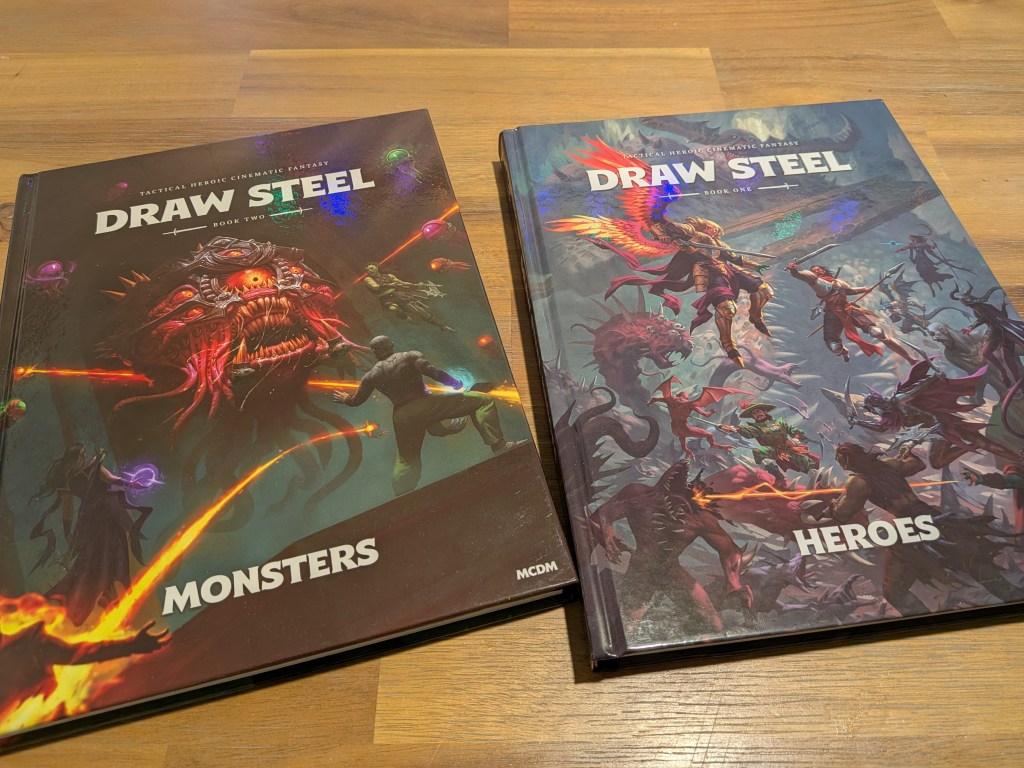
(I talk quite a bit about my relationship to MCDM and the first Draw Steel crowdfunder up top, skip to the section titled “The Game” if you just want the review.1)
I made a really stupid goal to write 13 reviews in 14 days at the beginning of my winter break. Three days ago, I finished a version of this review that was “good enough” and my mouse hovered over the publish button. Something about it just wasn’t right. So I completely re-wrote it the following day, but still… It’s 4am after my third full re-write and I hope I captured the love I have for this game.
I owe a lot to Matt Colville. In many ways, he was responsible for my entrance into the hobby. I spent months watching, and then re-watching, his Running the Game series before I ever found a table to play with. Each video shares the same central message: “You can do this. You can run a game.” And I could. And I did.
Eventually I recruited a group for D&D 5e, and the game crashed and burned after 5 sessions. But I persevered and the second game stuck. I played with that group for over two years, and role-playing has been a part of me ever since. As I look back over the hundreds of sessions since I started, many of my favorite sessions can be directly linked to advice Colville gave out freely. Forgive me for my self indulgence, but linked below are a few of the videos I still think about often:
You could pose almost any question related to running action-adventure RPGs and I could refer you to a Running the Game video that was instrumental in helping me form an opinion on that topic. Even my approach to writing reviews is colored by his “Put the good stuff up front” mentality.2 All this glazing to say, the production of the MCDM RPG almost killed the immense faith I had in Matt and his team. “Almost” being the operational word.
The Crowdfunder
I was going to back the MCDM RPG crowdfund no matter what. Flee, Mortals! gave me enough interesting monsters to finish off my years-long 5e campaign with a bang, so I knew I liked their design, plus I felt like it was an easy way to repay Matt for all the masterclass that is “Running the Game.” I thought it was unusual in 2024 that they were selling a game that hadn’t been designed yet, but their design goals were compelling. No attack rolls, fights that ramp up instead of dragging on, victory points that give passive buffs until they are cashed in for XP… I remember telling my wife, “This could be something really special” and justified throwing lots of money at the crowdfunding campaign.
Then all I had to do was wait. That wait was brutal. Initially I was subscribed to their patreon to follow “Designing the Game,” an interesting peek into how the sausage gets made. But I learned that I really, really do not like knowing how the sausage gets made. I would see an interesting rule that would capture my imagination, get excited and tell all my friends, then the next week I would learn that the rule was completely changed?3 They were ruining the platonic ideal of a game that I had built up in my mind! The closer we got to the full release, the more I had convinced myself that I was not going to like this game.4
I unsubscribed from the Patreon, and generally lost interest in development. I very briefly became a pathfinder-bro that believed Paizo could do no wrong,5 then Quinns expanded my mind that RPGs could be two friends pretending to fish for twenty minutes, and I fell out of love with combat RPGs generally. I felt like a completely different person from the one that originally backed Draw Steel. On multiple occasions, I would remember the crowdfunder and kick myself for wasting a couple hundred dollars on a game I didn’t think I would ever play.
Then suddenly I had the game in my hands. And I ran it for some friends across the world. And I realized that MCDM had delivered on all of their promises. They made a damn good game.
The Game
I hope you believe me when I say Draw Steel is my favorite combat fantasy RPG. They nailed their four design pillars to create the Tactical Heroic Cinematic Fantasy game. MCDM took the approach of making a game with a clear identity, and potential players could take it or leave it. Plenty of smaller scale, single-author projects nail this cohesion, but it’s rare that I see such a tight vision executed with a team as large as MCDM. This is especially true in the wake of the OGL issues that resulted in dozens of “D&D killers” that took notes from Wizards of the Coast, games with weak identities in an effort to be as inoffensive as possible. Anyone calling Draw Steel a “D&D clone” isn’t paying attention.
So what makes this game so great?
No null turns
I am so over the D20 style attack roll. Nothing kills the light in my eyes faster than trying to do the one thing my fighter should be great at, only to whiff the attack and have to wait another 10 minutes before trying again. All attacks and abilities hitting is one of the easiest ways to pitch this game.6
Every time I bring this up though, someone inevitably will argue that it just means they are artificially inflating health and could achieve the same outcomes with attack rolls. To which I say: Why are we using attack rolls as the default? Because of Gary Fuckin’ Gygax???? Who cares? Also, psychologically, they feel different. Even if the math behind the curtain was exactly the same either way, I prefer getting to make tangible progress every turn. For tactical, combat-focused games this is a winning design choice.
It doesn’t work the way a game like Into the Odd does though, you roll 2d10, then use the result to look up the effect on the associated ability table. I thought the table look up system would really slow things down, but damage amounts are static and static ability potency is used instead of saving throws against non-damage effects. That means everything is decided based on one roll, and the only math you have to do is add two d10s together. Each resolution is fast.
Heroes are heroes, from level one
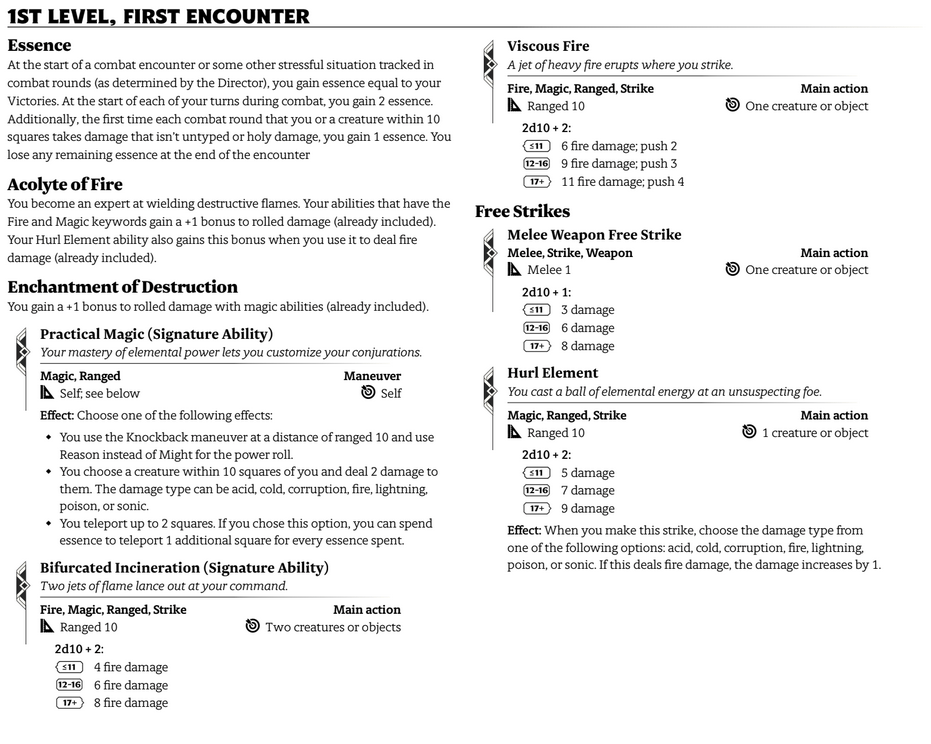
(First page of abilities from the pre-generated Elementalist for “The Delian Tomb” adventure)
They stuffed characters full of abilities. The full pre-generated elemental has eleven combat options at level 1, eleven! And that is on top of all the interesting basic actions all characters have access to. These abilities interact with the each class’s unique resource, often either adding to the resource pool for making choices in line with class’s thematic identity, or spending the resource to pull off powerful maneuvers.
For instance, the troubadour, a swashbuckling jack-of-all-trades, juggling fencing, acrobatics, and musical accoutrements uses drama as its heroic resource. Every time something dramatic happens on the battlefield, you gain the resource:
- Heroes all act together on the same turn like an Avengers action scene? Drama.
- Hero rolls a critical hit? Drama.
- Hero dies? Believe it or not, drama.
If you have enough drama as the troubadour, you can just come back to life as if re-writing the script on the entire adventure. Holy shit MCDM, that is some seriously cool class design.
The only time this expanded class design was a problem was that we often had situations where one player’s action triggered actions from multiple other players, letting multiple heroes act in tandem, but often causing us to lose track of whose turn it was in the process. I think I would be annoyed by this in any other game, but I’m playing DRAW STEEL for the combat, and it is fun enough that I don’t mind additions. I am sure system mastery will reduce some of the friction and increase the amount of insane combos my players pull off.
I get shivers just thinking about it.
Dynamic battlefield
Forced movement is a huge part of Draw Steel, so much so that the basic rules reference includes information on how to throw creatures through various materials, and how much damage each causes.
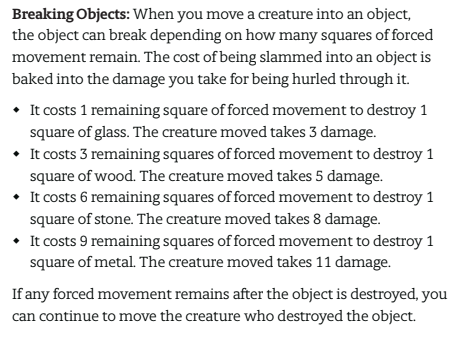
There was no attack of opportunity gridlock or flanking conga lines, players often had to move to do maximum damage. And I can’t stress enough the importance of the damage from forced movement. In every tactical combat game I have played, players have wanted to throw NPCs through a window or ram them into a wall, and most other games just don’t give you anything to handle it. To me, that is further evidence of MCDM designing toward the way people want to play.
I do have a small quibble though. At level one, damage from forced movement was almost too good? Throwing a goblin into a wall for thematics is amazing, but it gets old fast if it happens 30 times in one combat because it is the also optimal damage option. That said, I expect this becomes a non-issue as you climb the in level and play in more settings than just claustrophobic dungeons.
Monster design
I cannot say I am surprised that they nailed their monster design. Flee, Mortals! is the number 1 book I recommend to D&D 5e players. Now they are unbound by WotC’s sensibilities and building their own system unlocked a new level of clever monster design.
Their PC level adversaries feel very similar to other tactical combat games, but solo enemies and hordes are where they shine. The second combat I ran had something like 20 adversaries. In other systems this would be a death sentence, not necessarily for system balance reasons, but because the sheer number of turns would kill any interest in the game. Instead, we had heroes smashing through piles of enemies, and the hoards attacking back as squads. Sometimes those hordes got special abilities unlocked by their squad leader, giving PCs extra mini-objectives to pick off the elites.
And solo combat is historically tough, the only other game I think that does it really well is Hollows, often the PCs can just go nova with their abilities and the fight is done in round one. Or you have to wear down the PCs with a long battle of attrition before getting to the boss fights which is so boring. I don’t want to fight 100 zubats before I can battle Misty. Balance the game so I can walk straight to the boss if I need to.
So how does DRAW STEEL approach this balance problem? They let boss monsters break the rules. Just like players have their heroic resources, the director gets “malice” to use against players. It lets you trigger nasty abilities to fracture and dominate your heroes. I had a single sorcerer dragging players through shadow portals and slamming them onto sacrificial tables, blasting off elemental cones and deflecting attacks with a veil of pure darkness. It was cinematic.
The Art
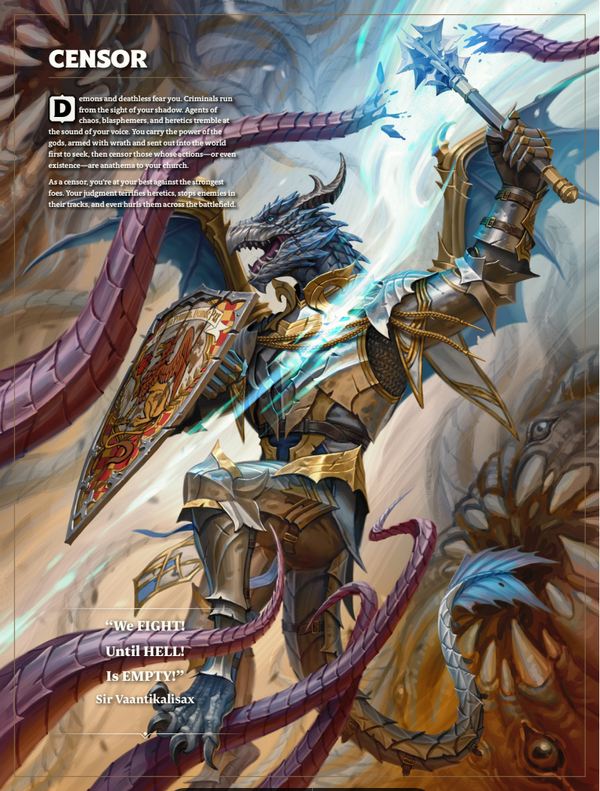
(Art from Draw Steel: Heroes)
The art and layout of Draw Steel hearken to older schools of roleplaying. The art reminds me of the fantasy books I carried around in my too-big cargo pants pockets in middle school. It feels like I should get a whiff of “old library book” smell every time I open the rules. It evokes “Dragon Magazine: HD Remastered.”
This is where I am officially telling you to buy these books. The art alone is worth it. I would hang these prints on my walls. I think what impresses me the most is the light and motion. Look at the image above, that is heroic and cinematic. And this isn’t just a cherry picked image, every piece of art is in great service to the themes of the game. Two minutes of flipping through the heroes book has ideas whizzing through my mind of the great stories we could create with this book.
I applaud art directors Grace Cheung and Nick De Spain for maintaining a consistent vibe across both the player guide and the monster book despite more than 20 contributing artists. I must admit that I am not totally inspired by the often bare-bones two column layout on a plain white background. It doesn’t pop off the page the way many of my other favorite games do, especially in PDF form, but it looks really clean in print and is very usable at the table.
The Adventure
I ran The Delian Tomb, the adventure Matt first made on camera for a running the game video to get people “running the game, tonight.” I would not be surprised if it is the most played intro adventure to D&D 5e, and now it has been remade and extended for DRAW STEEL. It’s my ideal, “You meet in a tavern…” adventure.
As this is the intro adventure, they did something I first saw in Fabula Ultima. It is written such that a group of new players could pick up the adventure and run the entire game immediately, with the rules for both director and heroes explained as they go along.
My only caution with using this adventure is that there are a lot of encounters. Even trying to run the first act of the game, I had to cut out one encounter and reduce the scale of the final boss to make sure we fit it into 3-4 hours, and that was with a strong focus on combat and very limited roleplay. I think you could very easily get 4-5 sessions out of this adventure.
The Recommendation
You should buy this game, though you don’t even need to buy it to read it. All of the rules are available for free, though it is without the layout and beautiful art. The Delian Tomb is on sale for $10 right now, and is packed with art, all the rules you need, and pre-gens for all the heroic classes. If I were you and wanted to test out the game, I would buy the adventure, run it, then get the hardback books.
Or, if you have the cash, buy the hardback books right now and run the Delian Tomb while you wait for them, they really are that good.
Acknowledgements
An enormous thanks to Matt Colville, James Introcaso, and the rest of the MCDM team. You all smashed it out of the park with this one. I am sorry my belief wavered for a short time, but I am back on team “Buy everything from MCDM.” I wish you all the best in your work to build the future of this great roleplaying game.
DRAW STEEL can be purchased here. And if you are looking at this before Jan 6, 2026, you can go and support the crowdfund for CRACK THE SUN! This includes the game’s first major campaign book (that I will absolutely be running), as well as a book of encounters you can slot into any game (I love that concept), and some expansions to the game and its setting.
At this point it probably sounds like I am a shill for MCDM, paid to review them as the campaign ended, but truly this was just extremely convenient timing for a game I truly love. I could write another three blog posts on this game. I have covered the absolute essentials in hopes to get you hooked, but the wealth of design in this game runs deep. DRAW STEEL is a river to its people.
Thank you to my players: Gemmelli the holy censor, Swisscheese the fiery elementalist, Ben McKenzie the calculating tactician, and to TundraFundra the overdramatic troubadour. I couldn’t have done it without you. At the end of our playtest, we all talked about how much we liked the combat mechanics and the characters, etc., etc., but none of us were looking for a game this combat focused. Which maybe is still true for them, but ever since we played I have had this little itch at the back of my neck to run this game in a long heroic, epic fashion. I hope to make a long haul review on this in the not too distant future.
A special thanks to kraftpaperhat. I no longer use the great branding he made for the site when it was still the Secret Sunday Sampler blog, but I just like him. He deserves more shout outs.
- I have never felt more like a recipe blog than when writing this. ↩︎
- I am not doing well at this today, sorry Matt. Though you are also known to start a 45-minute video with “This will be a short video” so maybe there is more than one lesson to learn here. ↩︎
- Give me back player-facing rolls MCDM, that’s all I ever wanted. ↩︎
- I want to be clear that Matt warned me this could happen, and that I shouldn’t fall in loved with any particular aspect of design because chances were likely it would change, but I couldn’t help myself. ↩︎
- Pathfinder-pilled if you will. ↩︎
- I know they are not the first game to implement this idea that all attacks and actions do something, but MCDM has been pretty clear that their design intent was not to make the most unique game, but to make the best game they could. I suspect a game with novel mechanics created for novelty’s sake and no other reason would be disappointing in practice. ↩︎
 Birdmilk's RPG Cafe
Leave a comment