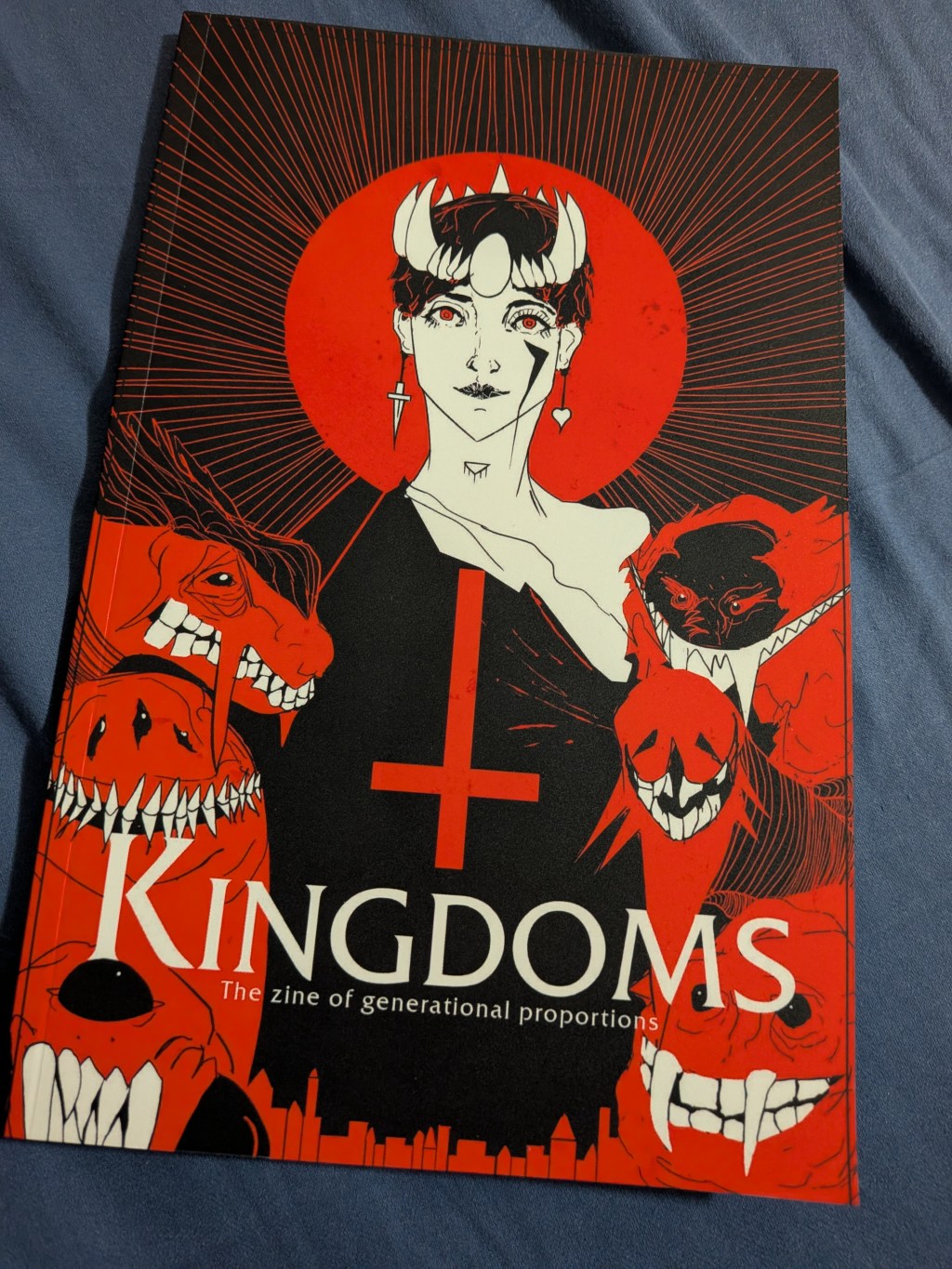
(Content warning: Imagined self harm)
Before we begin this review, let us engage in a meditative exercise. If you cannot remember the following sequence of instructions, you may need someone you trust to read this to you while you ponder. This should be treated as a solo journey, but companionship may increase its value.
Turn on some quiet music or the sound of a a dryer mid-cycle. Sit with your back against a wall and allow your thoughts to empty. Allow each one space as it passes by, do not assign it weight or value. Open your mind’s eye (your imagination) and picture yourself standing up (do not physically stand up). Send this imaginary form into your kitchen or garage, anywhere you can find something heavy and flat. Your father’s copy of 100 Cars That Changed the World will do. If it is a book, mentally open it and flip through the pages, try to imagine the words and images and how they fit together. If it is something else, such as the box for the Stanley 1/4 in. & 3/8 in. Drive SAE Mechanics Tool Set (150-Piece), then create the object in your mind. Inspect the individual pieces. See if you can picture the writing stamped into the metal. Once you have full rendered the objected fully, once you believe that it is not only the most important object in your home, but the most important object in the world, or, in fact, the only object that has ever been made, transfer the item to your left hand. Lay your incorporeal right hand onto your kitchen table, feel the wood, the impurities, the bumps and bruises over hundreds of meals. Consider the conversations had at this table. Do they make you happy? Somber? Tired? As you keep your right hand still upon the table, separate your hands in your mind, do not allow your right hand to know what the left hand does. Split your mind into two and allow your mental form to act accordingly.
Repeatedly smash your right hand with the object in your left. Return to your physical form and open your eyes and open your mouth. Scream until you are hoarse.
You are now in the correct state of mind to play Kingdoms.
The games haunts me. Every page is written as if the writer is trapped in a cave and desperately needs to extrude their thoughts lest the whole world face certain destruction, spreading their words across the walls and ceilings in blood and viscera. The ebbs and flows in the page layout do not suggest they were not made with the constraints of a zine in mind, but some greater being, formed to be chiseled upon the palms of some sleeping goddess.
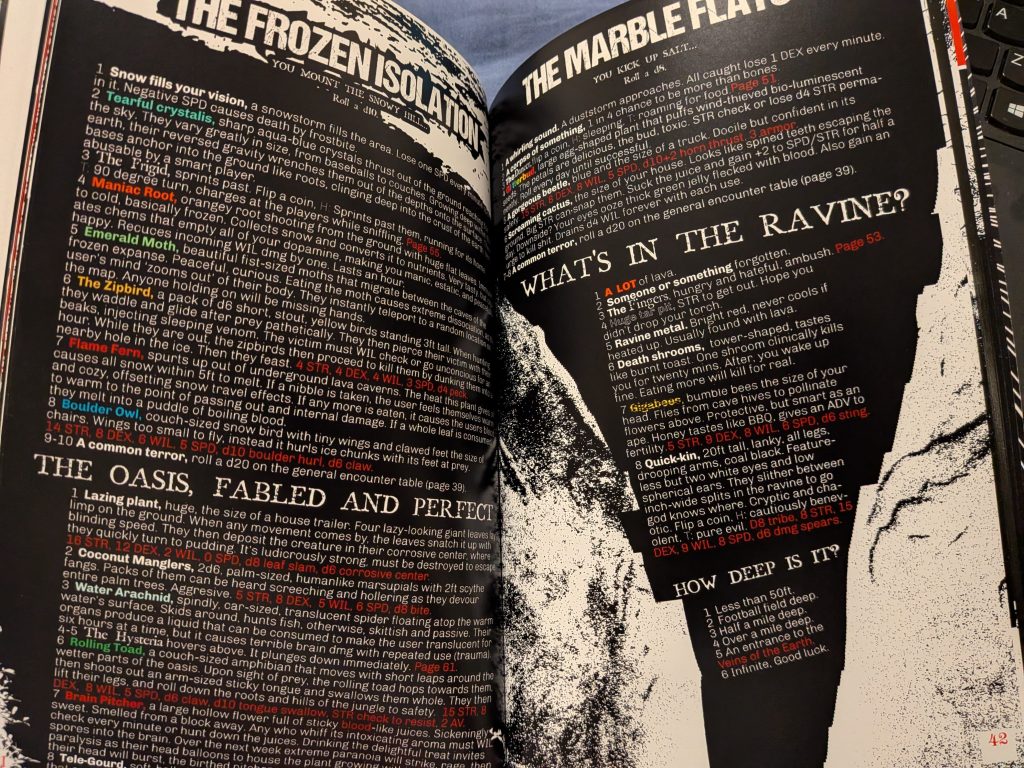
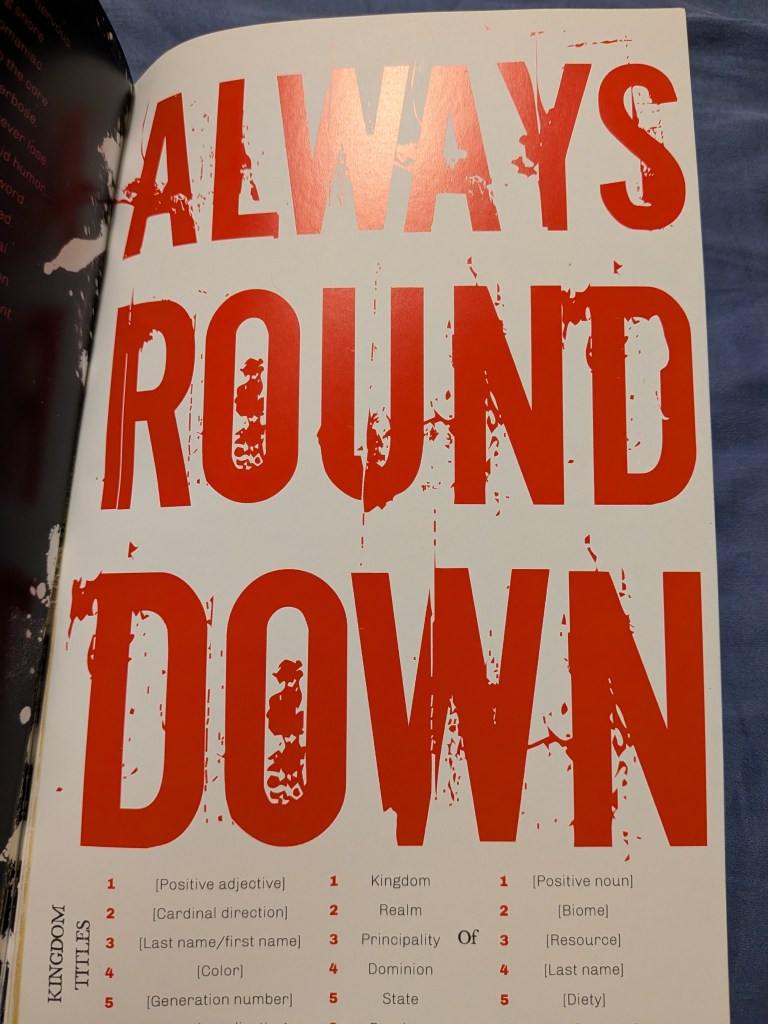
In some places information is crammed edge to edge, no space for margins, in the smallest font still readable. On another page, Tinney has used the majority of a page simply to remind you to always round down. There are no smooth transitions, Every page seems to have a new font, adds colored text that wasn’t previously there, or reveals heavily scratched drawing, reminders of your bleak mortality.
The game is simple, players are Godbloods, towering demi-gods with supernatural traits and abilities trying to build their kingdoms in a world with no sun and a darkness that is actively hostile to their existence. And make no mistake, these little god-kings-to-be are not benevolent. They grip onto whatever shred of prominence they accumulate through back-door deals, cruelty, and sheer force of will. Their only goal is to leave a lasting mark across the generations. Most will be snuffed out.
Read the bones
The mechanics are smooth, it uses the bare bones from Into the Odd, then builds a masterwork of multi-generational struggle and trauma on top of it. Players roll up Godbloods, 10 foot tall nobles, blessed with superhuman traits due to the nature of their ancestry. Blood traits include crystalline skin, wings, multiple heads, blood of fire, and several other …. “boons.” Characters also have base traits such as double carrying capacity, resistance to poison, or a bonus to hurt or disempower other humans.
Even with these traits though, they fight and die like other mortal men, accumulating grievous physical injuries and unsettling mental traumas. But death is not the end for any player, as they play not just a single Godking, but their whole royal line.
While I was only able to play through one age, ideally players would make choices across multiple generations, potentially thousands of years, and 5 different ages of technology. If players have wisdom and foresight, they will seek-out well-suited mates, have offspring stronger them themselves, and pass on ancestral relics of untold power, preparing their progeny to face off the beasts of endless night.
They may choose a more dramatic path however, seeking love instead of a good breeding pair resulting in weak descendants, or they will strike out against the great beasts without proper preparations and bring an early end to their family line. And even for Godbloods that are safe and survive, children are not a guarantee. Breeding has a 50% chance in resulting in deep trauma including death for either the child or the mother, or to result grievous injury to the child.
This idea of a generation spanning adventure, filled with bloody battles, court politics, and chivalrous romance is not new, Chaosium first printed printing Pendragon in 1985! But Kingdoms fits the whole age spanning game into a tight 82 pages. And Kingdoms is not telling stories about knights in shining armor. Kingdoms is bloody, dark, and desperate.
The power of procedures and tables
The only prep I went into this game with was the provided map and a dream. The players chose their place in the world and we did a completely table generated hexcrawl that resulted in deaths for three out of four of the godbloods. The game delivered on its deadly promises, and I am confident that we could have continued our generational adventure for several more sessions with no additional prep from me.
The game hosts three major sets of procedures, one for downtime advancement, one for exploration, and one for the great beasts in the dark.
The downtime advancements have you leading your armies, researching things divine and technological, cultivating trust and bonds within your family, and running your kingdom. These activities can lead to great boons and major increases in the reach of your throne, but they also hold tragedy in their lines, waiting to spread death and trauma across your household.
The exploration tables are the ones I most enjoyed reading, and am most likely to port into other games. There are six distinct environments, each filled with nasty surprises for any Godbloods willing to venture out into the dark.
The final major procedure are the beasts, mythical beings of the darkness made to terrorize humanity, including a behemoth to bring about the end of the world. Each beast has its own spread, a force of nature that will level towns and destroy whole populations if left unchecked. And in the early generations of night, there is nothing that your pcs can do but cower in the darkness and pray the beasts do not find them. I was generous and even gave my players extra gear from the steel age and extra starting relics, and after they faced off against a crystalline gorilla (a “regular” enemy) that nearly wiped the group, it became abundantly clear they were nowhere close to being able to face off against even the weakest beast.
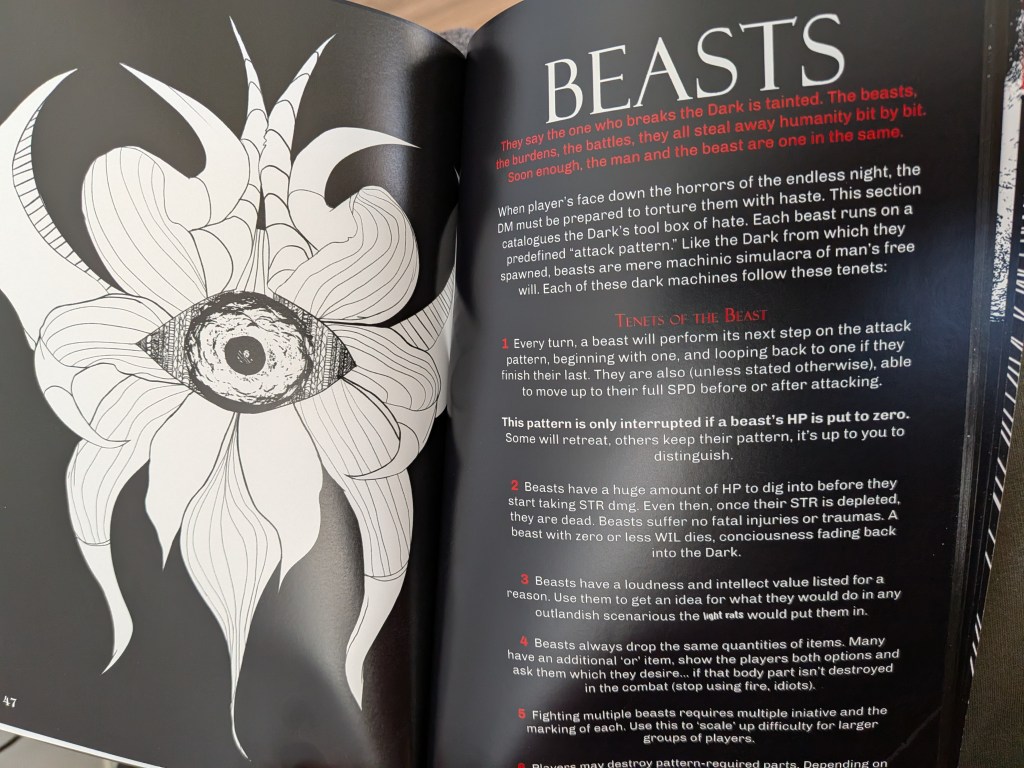
They need to hunt the beast though. The first Godblood to kill a beast is deemed the Godking and given true light, invaluable and deeply powerful against the darkness. Though now a tier above other Godbloods in strength, the Godking is still mortal and passes its light to whatever hand slays it, or its heir in the unlikely event it survives long enough to die of old age.
Glorious treachery
While not including any specific rules for player versus player encounters, Kingdoms clearly expects that your characters will be ruthless, conniving, self interested pricks. My players got the vibe immediately, which frankly surprised me. Many a time I have seen games try to make “evil parties” or “anti-heroes” work but so often my players natural heroic tendencies take over and they do the right thing over the selfish thing. Not in Kingdoms. And if they don’t get the program immediately, the game gives you traitors to nudge the players with, and ensure someone dies to their closest ally. You should not be trusted.
I think the setup that players are acting as these oppressive feudal lords invited them to be horrid to each other, and made them more accepting of seeing their plans dismantled by their “party” members. There was no redeeming these characters, no sympathy for their actions, and the best outcome they could be given was a horrid death and an unmarked grave.
Remember the three deaths I mentioned in the first session? They can all be traced to selfish actions made by the other players, including directly malicious acts to kill their sibling godbloods. In fact, the only reason one survived was due to an impressive streak of saves against poison administered by another character just before the end of the game.
Recommendation
Anyone with more than a budding curiousity in the OSR should at least pick up the PDF for this game, and the physical zine if they can get their hands on it. This game is tight, it knows what it is, and it delivers on it. This is months of gruesome, gritty, epic levels of play smashed into 82 pages, with tables that can be easily harvested to add a disturbing bent to any your favorite other games. The value far exceeds the price, and I am excited to see the most recent game Tinney has put out: FEVER DREAM NEXUS.
Truly my one complaint, if it can be called that, is that in many places the form of the zine is prioritized over the functionality. Several layout decisions make the search function unusable in pdf form, and the need to smash items in where they fit results tables showing up in unexpected places. That said, I don’t care! I don’t want the sterilized version of Kindgoms. The deranged energy that it brings into the book is a major selling point to me, and sets the scene for everything that happens within its pages, and thus at the table. In fact, I would not be surprised if I learned that the disjointed content outlay was intended to cause frenzied flipping of the pages through play, furthering the feverish experience.
This shit slaps.
Acknowledgments
Kingdoms can be purchased here.
Thank you to Sophia Tinney for stretching my abilities as a GM. While flipping through Kingdoms I worried I had bitten off more than I could chew, and would not be able to run something so bleak. But, as it turns out, I did not have to inflict much pain onto my players, they did it to themselves
Thank you to my players: Hat!, El presidente, Bogle, and TundraFundra. Four brothers entered into a contest for the crown, and the most gruesome (barely) survived.
P.S. In games like this, where you are playing truly the worst people, take your safety tools and any above table conversations seriously. While my players never got into anything too close to home, these stories could easily stray into traumatic themes and quickly sour the experience if not everyone is on board or feel comfortable communicating.
 Birdmilk's RPG Cafe
Leave a comment