
(Photo by Avi Werde on Unsplash)
Before we start, I want to note that Delta Green inherently is a game where you engage as armed operatives of the United States government. While I do not think the game explicitly paints these agents as heroes, disturbingly I would not be surprised to learn that there are many tables who treat these agents as “the good guys.” Given the current atrocities being committed by ICE and the federal administration in Minnesota and across the US, I would not blame you for skipping this review and focusing on what you can do to fight evil in the real world.1,2
Imagine we are all laying under a blanket in a tent in the backyard of our childhood home, with a flashlight illuminating our little fort, telling ghost stories about the dog under the bed and the call coming from inside the house. It’s all fun and games until we need to go to sleep and we just can’t get those images out of our heads. That will be your experience playing Delta Green but the stories will be much much worse.
DELTA GREEN
The first bit of this review is going to be spoiler free. I want to re-review Delta Green’s system now that I have full campaign under my belt, then I’ll get into Impossible Landscapes, a true monster of a campaign.
I think Delta Green has one core central tenet that has completely changed how I play other games. I’m going to call it the D-RAD system:
- Don’t
- Roll
- Any
- Dice
I am serious. Don’t. If you are wanting to play a game with a lot of clickety clackeys, find something else, Delta Green is not for you. We probably averaged four dice rolls per session. Four dice rolls. This would have killed trad-gamer D&D me. But rolling dice is not what Delta Green is about. It is about being careful, cold, calculating. Being paranoid around every corner, never taking a risk, and above all else: Run. Always run from danger. Running isn’t for cowards, it’s for survivors.
D-RAD is built into the mechanics. As long as a player has a high enough stat, they explicitly don’t have to roll.3 With just a 40%, you’ll be skipping most checks related to that stat. One of my players had a 90% in bureaucracy. He could have requisitioned an airstrike without batting an eyebrow, much less rolling any dice. The unfortunate corollary is that if you haven’t invested in a skill, your chances of success are extremely low, usually 20% or less.4 It means you probably aren’t rolling for the stuff you are good at and aren’t choosing to do the rest.
While Delta Green reads as quite traditional, with a thick player’s handbook covering an extraordinary number of possibilities, the core mechanic on its own is very simple, and most of the additional rules are modular. You only use them when you need them, so the complexity is never that high at any given time. That is, until you hit combat.
Combat truly is terrible. I don’t know if it’s so bad because it is poorly explained in the rulebook or because the mechanics are genuinely bad, but you could almost hear a groan from the book any time combat would start. Every single time I was flipping through the rules, double checking I understood new interactions like what would happen if an NPC fires into a crowd of people with both NPCs and the PCs and the gun has lethality and a kill radius that covers some of the PCs but not all of them. Could they dodge? Did it matter if they had taken their turn already?
There is going to be a clean, systematic answer in the book for this and 99% of other unique situations players find themselves in, but unless you are already well entrenched in the system, it is going to take 5 minutes to figure it out. And remember! The answer determines whether the PCs live or die, so you better get it right.
That in a nutshell is why I dislike the combat so much. Despite having an iron-clad logical foundation, at any given stage it is never 100% clear to me exactly what is going to happen or what the complete stakes are. That uncertainly takes all the air out of a lethal system and replaces it with confusion and frustration.
I am sure any Delta Green readers are sitting atop their pile of bones and shredded character sheets thinking, “Skill issue,” and they are right! If I had better system mastery, this wouldn’t be a problem, but remember, I played this game for 14 total sessions. I read the agent’s handbook multiple times, and still found myself in the rulebook figuring out what should happen. When do you get enough system mastery to not feel achy when initiative starts? I certainly don’t think it should be more than 10 sessions!5
In most non-combat cases, the handler needing to flip through pages to find the right minor rules is a charming part of the game. The GM takes the place of a under-paid government worker desperately trying to stay afloat amid their sea of paperwork. That is great if a player is trying to embezzle illicit cash from an operation, but I don’t want combat to share that bureaucratic affair. It should be lean, dangerous, and above all else, clear.6
Okay. Just so I’m not misunderstood, I think Delta Green as a system is an amazing training ground for GMs. I had always seen the advice to only call for rolls when it makes sense or would be impactful, but Delta Green pushes that to its limit with D-RAD. After Delta Green, I was running all of my games differently, always pausing to think if a player could just do it before asking for a roll. For that I am grateful.
For a Delta Green sicko who knows they are going to play it for years to come, the granularity is great. For the rpg tourist like me, I think I would love to get the full Delta Green experience for the first 3-4 sessions so players could get a feel for their characters and how often they don’t need to roll, then I would seriously simplify the system, especially combat.
Recommendation
Regardless of my personal struggles with the system, I think you should play Delta Green. Almost all of my struggles deal with combat, and ideally you do as little of that as possible. Learn to love the D-RAD (Don’t Roll Any Dice) system, embrace it and grow as a game master.
All of that aside, the real reason you should play Delta Green is because they have some of the best written adventures at the game store. Certainly the best investigations I have ever read.
Spoiler City
Have you ever heard the old adage about how to eat an elephant? One bite at a time? Well, the real answer is you just can’t. Eat what you can.
You can’t run all of Impossible Landscapes. This adventure feels like it was designed to create imposter syndrome in even the best of GMs. You are going to open the book to prep and realize that Arc Dream created a whole other separate book to help you keep this book straight. Then on top of that, there is a whole other discord server devoted to new handlers running this game, filled to the brim with good advice, incredible rewrites, and more player handouts and activities than you could possibly keep track of, much less use.
The adventure starts with 33 page timeline. It starts in the year 1402, which is 593 years before the first act takes place. It is unhinged. The rest of the book is similarly detailed, giving you information for contingencies upon contingencies. It has details for just about anything the players might think of. My table “missed” more than half the content because they just didn’t expect the adventure to account for so much. There are fourteen pages devoted to what happens if the agents investigate one specific nurse, though it never explains why they would look into her over the rest of the equally strange staff.
But we didn’t “miss” that content, not really. It became clear as I was wrapping up the campaign that not seeing everything is part of the game. Your Impossible Landscapes game is bound to hit some of the same beats as every other run, but it will be uniquely yours.7 This is true of all pre-written adventures, but the adventure space here is so large that it becomes a full sandbox investigation with the same level of player freedom as GTA VI. Dennis Detwiller gives you everything you could ever need, then the community piles more on top. Have you seen the sign? The only limits are how much the handler can ingest and buffer at the table, and how brave the agents are to seek out dark secrets.
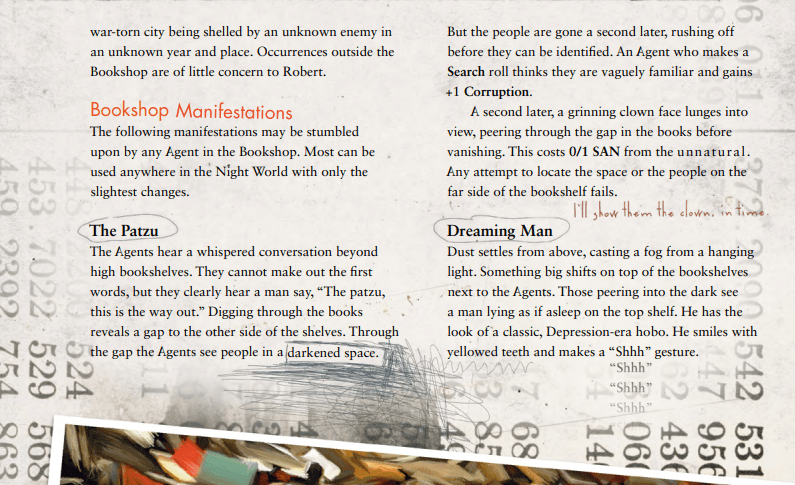
Now, being given this much information would normally drive me crazy, I tend to be a bullet points and pretty art kind of guy, but the book itself is almost an ARG for the handlers. There are secrets and puzzles hidden in the text, scribbles in the margins with different authors leaving clues the players will never see. It would absolutely have been worth the read even if I never played the game. The layout of this book is a masterwork, almost too good. By the end of book you may go mad along with your players. I never slept well after a day of session prep. Even as I write this, I jump at sounds outside my office door.
has gone to sea cross the waves to rescue me in a ship both tall and fine she round the corner marking time
And that is maybe the only caution I would give of running Impossible Landscapes: It is often disturbing. The book has a repeated themes of drowned children, including a possible side mission where agents are asked to catch “rats” in the airducts only to find dead children. I removed and replaced much of this content. It was simple to do to keep my players from having to experience it, but I still shudder thinking about it. This is capital “H” Horror.
Impossible Landscapes created some of the most tense, harrowing, and genuinely emotional roleplay of any game I have ever experienced, but it came at a cost. Engage at your own risk.
Acknowledgements
Delta Green and Impossible Landscapes can be found at Arc Dream Publishing.
This book is a love letter to roleplaying. I cannot imagine the amount of work that went into just the writing for the adventure, not to mention the art, and mind-bending layout. Thank you to Dennis Detwiller and the rest of the incredible team that made this possible.
In that vein, thank you to the huge Impossible Landscapes community that created countless free resources for running and enhancing this game, then took the time to answer my many absurd questions.
And, of course, an enormous thank you to my players who set aside an 3 to 4 hours of the Sunday evening for 13 sessions so that we could all experience this together. It was unforgettable.
kraftpaperhat as the FBI agent Tommy who only cared for his wife and child, lost everything to his job, and died trying to literally burn down the whisper labyrinth.
Gemmelli as the firefighter Gary with a lost love and a troubled past that died upon grasping the weight of giving Author X his spirit bottle, before being returned to usher in the end of the world at the end of the world at the
Kyle as supernatural investigator Felix Rusk, who dared summon demons even in his last moments before being consumed by The King.
NO MASK NO MASK
And finally to TundraFundra, the pilot Frances who survived against all odds, if you can call it surviving.
- Find ways to contribute here. ↩︎
- I would like to say that you can come back to it in some brighter future where these horrors are contained to the books. However, my understanding of the campaign God’s Teeth, there is direct reference, critique, and condemnation of the US immigration “system,” so it is possible, likely even, that Delta Green will always reflect the worst of humanity back at us. ↩︎
- The game is percentile, roll under. The fact that this is in the footnote and not the actual review should help you understand how little I think the resolution system has to do with how good the game is. ↩︎
- This makes sense to me. The chances someone could disarm a bomb should be wholly determined by their training. If they have none, they almost certainly couldn’t do it. ↩︎
- A question about from another GM about how pinning interacts with parrying and blocking came up while I was writing this. ↩︎
- I am guessing there are people thinking that maybe I just dislike complicated combat overall. I am a certified Into the Odd sicko, so I wouldn’t blame you. But it’s not the case. I love a crunchy game. Hollows was my game of the year for 2025, with Draw Steel not far behind. I ran Pathfinder 2e for years and am currently running a Starfinder 2e game. The difference with Impossible Landscapes is that combat is much deadlier, so the margin for error is much tigher. Any mistake in a ruling could result in a character death, or maybe worse, a character surviving when they shouldn’t. ↩︎
- Thanks to several fellow Impossible Landscape handlers in the Quinn’s Quest discord who helped me understand this. ↩︎
 Birdmilk's RPG Cafe
Leave a comment