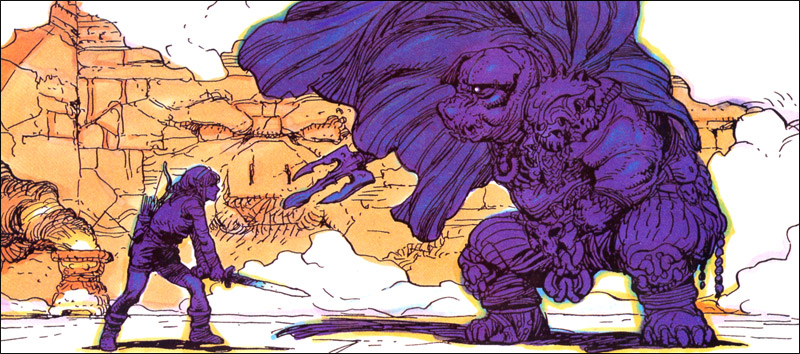
(Header art is a Legend of Zelda illustration for Nintendo Power from Katsuya Terada)
HEROISM.
Spencer Campbell has done something very special with WYRM.
During my extended stay in the OSR-sphere I have truly enjoyed being a dirty little guy going into a hole in the ground to get treasure. There is something charming about the reality that you are not special, you are not super strong or super smart, and more than likely, you are going to die. But sometimes I miss those higher callings, the type of game where the PCs are something special, and if they are careful and clever they might just become big damn heroes.
The idea of a “chosen one” seems diametrically opposed to the common genre pillar of high lethality. It’s easy to kill off a treasure hunter rooting around in a sewer because another one can fill their place in the time it takes to roll 3d6 down the line. But often heroic games don’t feel heroic because they have so many safety rails to keep a sweet PC from dying that throwing yourself into danger is no longer bravery, it’s just Tuesday.
I need heroism and lethality.
DICE.
The dice system Campbell cooked up is really clever and really brutal. All PCs and NPCs have a tier 1 – 5 and a dice1 size associated with that tier.
- Tier 1 <- D42
- Tier 2 <- D6
- Tier 3 <- D8
- Tier 4 <- D10
- Tier 5 <- D12
Seems simple right? The all challenges have a difficulty associated that is 4 + the tier level, and the PC has to meet or beat that difficulty using their tier dice plus any relevant modifier. On its face, all that seems fine, until you realize that a tier 1 character has a d4 + 1 on average and needs to hit a 5 to succeed at the easiest challenge.
That is BRUTAL. That is a twenty-five percent chance to succeed on a straight check. I have mentioned how brutal I felt Mörk Borg is, and the average success rate there is closer to forty percent. This is even worse than Mothership odds, a game that comes with a “high score” on the character sheet counting how many sessions your pc has survived. WYRM should feel awful to play even as a horror game, and truly terrible as a heroic game. But WYRM balances the pain with three important mechanics.
FRIENDSHIP.
Advantage is huge in this system. It allows you to increase your tier dice for a roll, which changes that average success rate in tier 1 to 50%, doubling your chances. That massive swing in the math makes this a game about teamwork. You should be doing things to give your companions advantage and vice versa. In the unfortunate event you find yourself in combat, the optimal play is probably not to attack, but to come up with clever ways to give a teammate advantage. I love when mechanics incentivize real teamwork and not just “I roll to hit” for every turn.
LUCK.
Besides friendship, the other major source of advantage is luck, a special resource that you get every time you roll the maximum value on your tier dice. A natural balance within the progression system emerges! In early tiers when you desperately need advantage to even have a shot at success, luck is common, then once you become a hardened, wise adventure, it is skill and experience, not luck, getting you through the difficult times. Beautiful.
MAGIC.
There is relatively little world building in the current version of WYRM, but one of the major items is that dragons are aliens that came to this world, killed the gods, then drained their blood for their heretical void experiments. The remaining drops of godblood crystalized into powerful and highly sought relics known as wyrmscales. Every player character has a wyrmscale embedded in their body, which grants them the title of wyrm and access to powerful spells. Every wyrm has the potential for something great.
Now spells are special because they don’t need dice. In this world where wyrms are faced with every disadvantage, magic just works. And the magic is powerful. The power to cast banish evil, turn the ground to ice, and heal otherwise deadly wounds. My personal favorite may be the ability to force a target to age multiple years in an instant.
The spell system is so great because it is available to all of the wyrms, so there is no “martial versus caster” bullshit and the spells are not heavily codified3 so they become a part of the problem solving toolbox instead of just something to spam in combat. Most importantly, because they just work, no roll needed, they are a source of consistency in the otherwise very cruel and failure prone world that is WYRM. Your characters will always be able to make impactful choices even when it feels like their dice are cursed against them.
SCALING.
The last piece of the puzzle that I think allows WYRM to be a true heroic OSR game is how it scales. While target difficulty increases by 1 for each tier, wyrm’s increase both their die size and their attributes. Assuming you mainly focus on one skill, your wyrm will go from only succeeding 25% of the time on a straight check, to succeeding 75% of the time on the hardest checks, and cannot fail lower tier checks. You gain big damn hero status, and enter world shaping territory. The progression is so simple, but so clean. That’s good game design.
Recommendation
I have more notes about this game that I want to shout from the rooftops including a very cool system for transmuting treasure into tools and that it is an absolute breeze to convert adventures for because of how sleek the tier system is, but at this point you should just go read the rules for yourself.
The whole rules for WYRM, along with a test adventure and hexcrawl are pay what you want right now. There is no reason not to check out this game. Skip your next scheduled doomscroll session and spend thirty minutes reading this little gem instead.
With how bleak things have been in the world as of late, it is nice to be a big damn hero, striking down the evil right in front of us.
Acknowledgments
WYRM can be found here.
Thank you to Spencer Campbell for making such a cool game. I have had my eye on his work some time. We were originally planning to play a game of Slayers, but just couldn’t help but switch to WYRM when it released. If you aren’t already following Campbell, you should be.
Thank you to Amanda P. who wrote Tannic, the adventure I used for this session. In many ways I think it is the perfect module to run for your friends that confess they haven’t tried D&D but always wanted to. It has a crypt, ghouls and ghosts, a carnival, and a dueling lizard riddler. Extraordinary.
Thank you to my wonderful players: Robinson as the jaded old austrian that saved the party from certain death by banishing an undead bard, xaitza as the jovial nomad that threw himself into the jaws of the beast to save two children from a lifetime of mind control, NinaNobody as the hero that gave her life to keep her companions safe, and The Z-Man CBG as the befriender of ghosts who returned with blood and hellfire to avenge Nina’s death.
And extra special thanks to Robinson for turning me on to the very cool art of Katsuya Terada.
P.S. It’s a mess out here in the real world and there are no clear signs of it getting better. I recommend everyone read this piece by ProPublica that contains letters from children being detained in concentration camps by the US government. It may result in a breakdown of tears in the middle of your workday and a general loss in hope of humanity, but the discomfort in the knowledge will hopefully push us to act. Giving money and support to foundations and funds like the Immigrant Rapid Response Fund is an obvious way to help, but if you aren’t in one of the hotspots for these atrocities, it may feel like there is not much else you can do.
Look to your community. Volunteer at your local library, your kid’s school, a local soup kitchen, anywhere you can. I guarantee there is a need you can fill right now, and it will better prepare you and your community for when disaster does inevitably strike close to home.
- Round here we believe in zero plurality for dice. ↩︎
- The real statistics sickos will see this and know I have been doing all my regressions in R. ↩︎
- Maybe my one major complaint about the system is that the spells don’t have ranges, so often it was unclear if the wyrm needed to be touching something for the spell to activate, or if they could cast it thirty feet away. There are already abstract distances for combat, I imagine it would be straightforward to apply them to spells, but it is annoying to adjudicate on the fly. ↩︎
 Birdmilk's RPG Cafe
Leave a comment