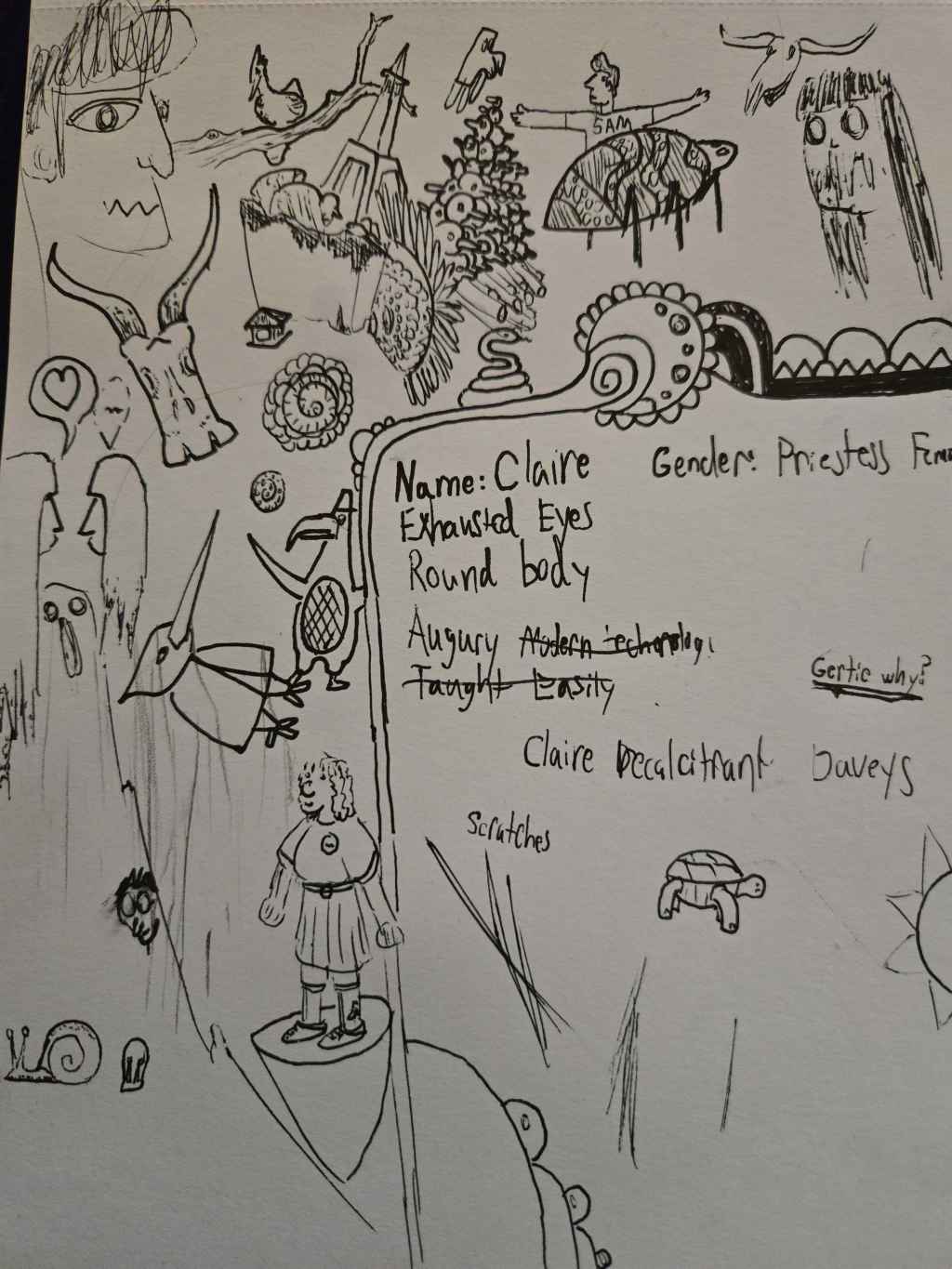
(Header image by Bogle, one of our great players)
Not every game is for you (or for me for that matter). In an industry where the biggest fish avoids making any interesting choices in favor of offending the fewest number of tastes, Jay Dragon is making games that are unapologetically about something. Sleepaway plays out as a horror film, with an archetypal, nostalgia-inducing summer camp being terrorized by the shapeshifting Lindworm, and players acting as camp staff trying to keep everything together. In an interview with Quintin Smith of Quinns Quest, Jay said, “Sleepaway is for me and my five friends. … I am so not concerned about broader appeal.”
Despite that, I think everyone should play Sleepaway, at least once. In the last year I have played quite a few new ttrpgs, many of which I have deeply enjoyed, but nothing that really compares to the experience of Sleepaway. I don’t know quite how to explain it. It was as if the game stripped away my carefully formed protective shell and left my emotional nerve endings raw and exposed.
This isn’t just a facet of No Dice, No Masters games (the underlying system Sleepaway uses) either. I loved playing Wanderhome, it was like an ASMR1 rpg experience, but the experience of Sleepaway was entirely different. Let’s dig into what makes this game so unique.
No Dice, No Masters
No Dice, No Masters games are lightweight, diceless games that use tokens to incentivize players. Each player has a distinct playbook with weak and strong moves. Weak moves create tokens when used, and you must spend tokens to use strong moves. In general, weak moves entail your character causing friction, often by being selfish, toxic, cowardly, or annoying. In turn, strong moves let you act with strength, direction, courage, and passion.
I played the counselor, and my two favorite weak moves were “Tell a camper a harsh truth in a way that hurts them.” and “Lie to a camper. They can tell it’s a lie.” Not only was I expressly allowed to make unkind choices, I was incentivized to do so. In my opinion, the weak moves are what make No Dice, No Masters games come to life. They give you license to be heartbreaking in a way that no session zero can. I wasn’t just stabbing you in the back because I don’t like you or your character’s choices, I did it because I got a shiny token to cash in later.
To play the game, players have to show off their worst sides. These aren’t legendary knights in gleaming armor, always saying and doing the right things, these are fallible people, doing the things fallible people do. And because you need tokens to redeem yourself, the game starts with players injecting conflict into the story as often as possible. It all but guarantees a satisfying narrative arc by forcing weak moves and conflict in the opening, and ending with strong moves of passion and inner resolve as the game comes to a close. It’s elegant.
To top it all off, every player has the weak move, “Invite the Lindworm to act upon the group.” The most selfish move, to trade the safety of the camp for a single token. My blood ran cold every time I heard the phrase, and I felt real guilt when I knew how bad it could be and used it anyway. The campers were not alright.
Character Creation
Making my character presented deeply interesting choices. Name prompts included “a name formed by a single letter,” or “a round name.” Gender selection choices had “A Vast and Caring Body of Water” and “A Campfire.” The final piece was asking two questions of the other staffers, deeply personal questions that created multidimensional bonds between all the characters. We started the game, not as faceless playbooks, but as real people with multi-facted connections.
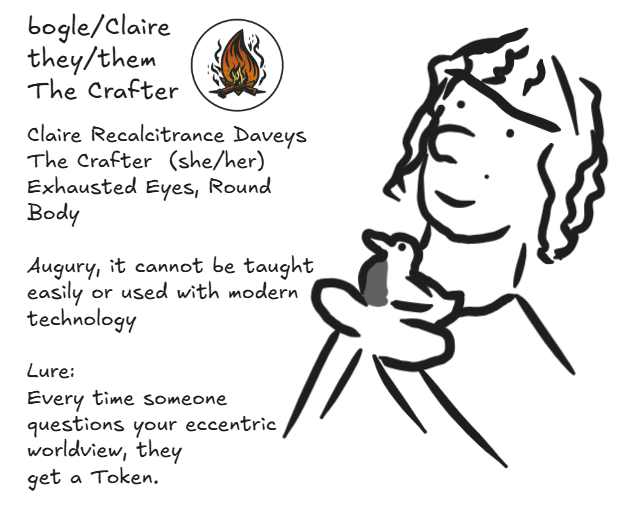
(Character notes and art by the magnificent Bogle)
The camp is the last character at the table, and all players join in to make it and embody it. This was a lovely process, and we made a summer camp that brought me back to my own days as a camper, with a glistening lake and solemn forests. The camp was not without its scars though. Fire had burned out some of the best trails, and much of the the prior summer saw a tragic and preventable death.
In some other reviews I have praised the speed of character creation, but in this game, character creation is not just paper work standing between you and actually playing the game, character creation is part of the game. Thus the “time to play” is dependent on how long it takes to pass out playbooks.
The Lindworm
I would be absolutely fine playing this game without the horror element. the character creation lead to some beautiful, emotional scenes about the camp’s past and our part in it. It really felt like I was sitting in the woods with friends I had known for years, dancing around our feelings as the cicadas buzzed through the twilight. To me, it felt like teen summer. The separation between me and my character was thin, thinnest of an game I have played. It was real.
But the Lindworm took that away, tore my dream world to shreds. That is its purpose.
No one roleplays the Lindworm. An anonymous player chooses consequences from inviting the Lindworm out of a limited hand of cards, and the consequences are set to get worse and worse as the game goes on, and all the players can do is try to survive and keep the campers safe.
This is where I think my personal experience diverges from Sleepaway. I am not deeply familiar with horror in general including summer camp slashers. As soon as we had the first serious danger to the campers, I was kicked out of the fiction of the game. I just couldn’t justify keeping the camp open. Why weren’t we just immediately sending everyone home? A world that was so immersive suddenly became contradictory in a way I could not resolve.
Had I watched more slasher movies, could I have imagined reasons why we needed to stay at the camp? Or explain why the camp had continued to exist despite the fact that all player characters have explicitly been harmed by the Lindworm before and yet the camp was somehow still open? Probably. But I think there is something more important that I was missing.
From what I understand, the Lindworm represents the ever present dangers that threatens queer folk and the necessity of community to protect against it. It is a opportunity for older, more experienced members of the camp to band together and try to protect the new members from the dangers they have already faced.
Those dangers are ever present, and members of marginalized groups can’t just “leave camp.” And like the Lindworm, those dangers are largely invisible to people outside the metaphorical camp. I am not a member of a marginalized community, I won’t ever really understand the struggles they face, and I feel generally inadequate to be writing about this at all. Like I said at the start, this game was not made for me. But I think its important I played it and spent time considering the gaps in my vision when it comes to the people I am interacting with every day.
This game wasn’t written for everyone, but I think everyone deserves a chance to play it.
– Brett
1 I know that the value and enjoyment of ASMR is hotly contested. Frankly I don’t like people tapping microphones with long fingernails, but I understand the concept of sound that helps you relax. The experience of playing Wanderhome felt like I was being wrapped in a warm blanket after a long journey.
Acknowledgements
Sleepaway can be purchased here.
Thank you to Jay Dragon for making games that challenge the standards and traditions of role playing games. Every piece of work I have seen from Jay has at least one element that makes me go, “I didn’t know rpgs could do that!” Sleepaway is no exception. It affected me deeply. Thank you.
Thank you to Sparky, who facilitated the game. I am not sure I would have gotten the opportunity to play Sleepaway without you. Thank you to the other players, strat for being the all star athletic coordinator, TundraFundra the forest sage ropes course coordinator, and bogle, the crafts master.
A special thank you goes to that very same bogle for sharing their notes and art with me, and as always to Hat! for making the Secret Sunday Sampler branding and lending some legitimacy to this little blog. I love the rpg community I have found myself in.
P.S. If you do Sleepaway, it is worth spending some extra time discussing the tone and goals of the game, and potentially even combing through the Lindworm deck and tailoring it to your group’s needs. Just a little work up front determining what the aspects of the game you really want to explore will pay dividends at the back end.
P.P.S. On that note, I have been thinking about safety tools a lot lately. I do lines and veils at the beginning of every session. I think it is basically a requirement considering I always play with strangers, and often have at least one new player each week, but sometimes I feel a little silly talking about the awful, depressing things that *won’t* be in a game just before we start, especially when playing something extraordinarily lighthearted and fun that is extremely unlikely to touch on the normal lines like sexual violence or child abuse. I don’t think there is a one size fits all solution, but I have been experimenting with trying to focus more on what we want to happen instead of just the lines of what we don’t want, inspired by Jay Dragon’s palette grid and Jason Cordova’s CATS system, and have seem some success.

 Birdmilk's RPG Cafe
Leave a reply to Lil’ Dips (Rapid Reviews) – Birdmilk's RPG Cafe Cancel reply