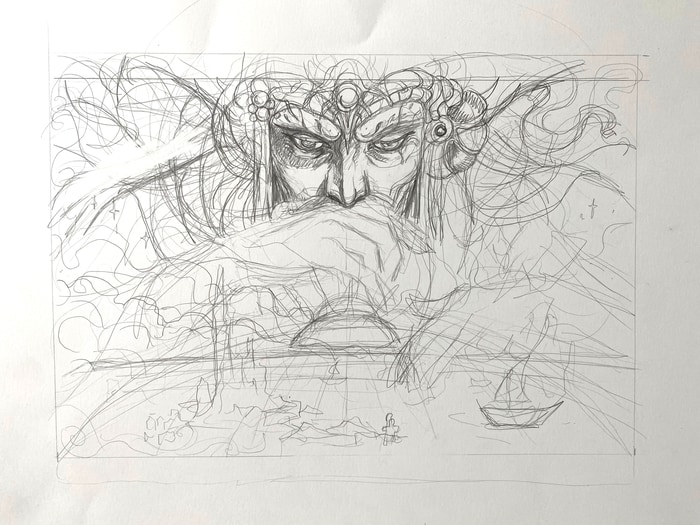
(Header image is a sketch from Justine Jones for shared in 7pp’s kickstarter)
This review was written by Robinson, good friend of the blog.
In the 4th grade, all the girls at MacArthur Elementary attended a sex ed talk. The boys, less physically and emotionally mature, were put into a single classroom with the principal and expected to do worksheets about personal hygiene.
It took about twenty minutes for the lads to make enough jokes about cleaning their balls that the principal took away our recess. This was a deep injustice that called for someone to stand up and point out that we were all being punished for the actions of two or three misdemeanants. I needed to say something, to stand up for the good guys. What I did was: start crying in the middle of a room full of every boy in the fourth grade.
The worst part was, no one made fun of me for it. Uncharacteristically, my friends and bullies all looked away in discomfort as I continued on my downward spiral of shame-crying. I made eye-contact with a kid that once forced me to eat a stick and saw fear in his eyes. Fear that crying might be contagious. Fear that, he too, might shame himself in front of the herd.
The principal first tried to calm me down, to give back my recess, and mercifully, to leave me alone to sort myself out.
I cried a lot as a boy.
I also spent a lot of time dreaming about being a wizard.

Seven Part Pact is a Table Top Roleplaying Game about being a wizard and trying not to cry. It was written by Jay Dragon and was the subject of a recently successful kickstarter.
At first brush the pitch is this: Be Saruman and accuse your old frenemy Gandalf of violating wizard law by giving hobbits a grand destiny that ruined your magical research while Radaghast fucks up your relationship with your secret boyfriend by letting his pet dragon nest in Minas Tirith.
It’s a Wizard committee LARP on top of 7 boardgames with a framework for every player to referee specific elements of the game world. It has a spellbook as long as some complete TTRPGs, and If you’re reading this review, then I imagine you find some part of that pitch compelling.
I found it so compelling that I sought out access to the unpublished playtest, joined 2 different discords, read hundreds of pages of rules, played it, devoured it, and allowed it to devour me.
I was one of seven players in a single session game. We played online through discord using the final version of the playtest materials (DRAFT 4),1 and shared game information through Google Slides. In the spirit of a GM-full game, I interviewed each of the players after our session and their feedback will be included throughout.
WE DREAM OF ANOTHER WORLD

The 7 Part Pact is unlike any TTRPG I have encountered.
It has been described as “GM-full” as opposed to GM-less, and I agree. If one GM can hold an entire world and system of rules in their head for an epic fantasy adventure, imagine the richness of a world contained in three to seven heads, each shepherding different “truths” of the game and world.
Tokoeka – Necromancer, Watcher of the Gates
I think the initial thing that intrigued (me) was the mere scale of the game. All of what I had seen, from the Quinns Quest patreon and the kickstarter, begged the question, how on earth does this thing run, since everyone seems to have so much to take care of, and in addition everyone runs the game as well.
I played the Faustian; a byronic mage with a tragic fate.

The Faustian’s game is played with a deck of cards and represents the machinations of the Pact’s chief antagonist, “The Devil.” Through play, cards are placed into the different communities of Isha, (the *Earthsea*-like world of Seven Part Pact),2 representing the work of the devil and other antagonists, with mechanical effects that echo across the other wizard’s games. The Faustian’s game has no win-state, and as-written will always end in the Faustian losing his soul to the Devil.
I was also the Chain-Watcher, guardian of the truth that everything has a price. I was responsible for playing the Devil in any scenes in which he appears, representing antagonists, consequences, and the escalation of conflict and tension. In this way I was a classic “antagonist GM” constantly looking for ways to twist the actions of other players towards tragic ends.
Every single player at the table held similar dual roles. One as a wizard and one as a GM.
In play, it was less “MANY BIG RULES FOR MANY BIG BRAINS,” and more “different narrative priorities all receive the dedicated attention of one GM”. In this way the game developed with narrative contributions in seven different layers like a bean dip stacked with homemade ingredients, each carefully crafted by a different cook and then combined in a smorgasbord of flavor.3
And it’s fuckin’ delicious.
Now, you might be asking, “Robinson, what if it’s done poorly? What if one of the players brings shitty store-bought guacamole and our dip tastes like a tex-wreck and not tex-mex? And yeah, I can imagine that being possible, but 7PP also benefits from attracting a pool of players that self-select for ambition and enthusiasm.
Wafflemancer – Mariner, Watcher of the Storms
That initial impression of needing 7 people who need to know everything seems overwhelming, but it felt quite ok, even as someone who has a lot of GM anxiety, you have a very defined role.
What is trickier, I think, is learning to pace a game that doesn’t explicitly give someone the job of editing scenes. We were constantly negotiating with other players for a shared spotlight.
It took us a while to find the rhythm of play, though we greatly benefited from a couple of experienced players. Our initial wizard’s moot meandered: What were we supposed to talk about? Who was in charge of ending the scene? When do I get to describe my super-cool wizard?
If you’ve ever watched beginner improv comedy with performers floundering in a scene that’s run out of steam, you’ll understand. It’s a group skill that improves with practice.
Timo – Hierophant, Watcher of the Flames
I hadn’t played many GMless games before, and it was really difficult to control scenes at the beginning, to know when we should cut off scenes.
And believe me, you won’t have enough time to let any go to waste.
ALL WIZARDS ARE MORTAL

I’m 42 years old with a wife, a kid, a dog, and a full-time job. I do not have very much time to spare. This made it difficult to find a game that fit my schedule but easy to get into character because the central element of tension in 7PP is needing more time.
Play unfolds across four weeks per month where each “action” takes one week, and you always have ten things that need doing. In my month of play I spent two weeks doing my job and two weeks searching for and convincing my girlfriend to come back home so I didn’t have to make my own bed. Guess which was more fun to roleplay? (HINT: She used witchcraft to shred the soul of an inquisitor who accused her of witchcraft.)
If players are likely to bounce off of 7PP before playing, I can imagine time commitment being one of the main reasons. It took a long time to read the material and schedule seven busy wizards. Once at the table, however, the time spent referencing rules or systems disappeared into the play like flea meds into a piece of cheese, vanishing into the gaping maw of our collective imaginations.4
Because every player is a GM, you are more likely to enter a “flow” state of TTRPG play. Our session ended in what felt like the blink of an eye; we played for five hours.
In fact, this is the first game I’ve played where not a single player wanted to take a break, even when given the opportunity.
Petra – Warlock, Watcher to the Throne
I have a hard time concentrating in online games sometimes, but with 7pp, having a GM role meant I was engaged constantly, listening in case I needed to act.
This has its own dangers and in a longer campaign I’d advocate for prescribed breaks to decompress and process play. It would be easy to let the game run away with your time.
Adrian – Sorcerer, Watcher of the Truth5
Sessions start to get longer and longer but scenes get less and less time… When you’re playing and having fun it’s difficult to stop. 7pp might be the worst culprit, it’s so tempting to keep going. You just want one more turn.
On the other hand, this pressure means you will pack more meaningful play into a single session of 7PP than your average dungeon crawl with the bros. And the bros yearn for meaning.
ALL WIZARDS ARE MEN

A lot of my early TTRPG experience was through the Boy Scouts of America. Between paramilitary rituals and hiking we would roll dice around a campfire, imagining battles in dungeons and outer space. Our characters were always male.
We were boys pretending to be men in more ways than we understood.
Seven Part Pact asks you to pretend to be a man even when pretending harms the innocent, the ones you love, or yourself. Even when your character might not be a man or even human at all. In the hands of a lesser designer, that ask could easily lead to a game that celebrates the aesthetics of the systems it purports to satirize (See: WH40K) or be powerful but unpalatable for long-term play (See: Train).
Instead, I found myself drawn to the fantasy and stories of the game while simultaneously re-examining my own experience within the patriarchy.
Timo – Hierophant, Watcher of the Flames
The times I’ve hurt people the worst were not out of malice but out of carelessness. I think that’s something men or male presenting people understand. We don’t tend to have socialized empathy as well as we probably should and that’s something I think about a lot… It’s kind of fascinating to explore that as the character, as the celestial audience to explore how your choices impact the world.
This is the sweet and sour of 7PP. You are an all powerful mage, but the system that grants you power will also poison you and everyone you love. Because you are also charged with making sure the poison stays potent, you constantly shift your perspective between character and narrator in a way that demands reflection.
Katiska – Sage, Watcher of the Stars
As a nonbinary person myself, who does feel weighed in my life by being heavily male-passing, it was refreshing to also play a character who was, very much not a man. Perhaps not even human at that point, but had to seem that way. Just because they, and maybe they alone, knew what sacrifice it would take for the Pact to be any other way.
It’s a process that weaves a spell as potent as any you will find in the game.
ALL WIZARDS ARE MIGHTY

I have never felt more like a wizard than pouring over the grimoire of 7PP. It is as much a prop as it is a necessary reference for your arcane powers. You will never memorize every spell or the countless combinations of runic effects that might occur in their casting, and that is clearly by design. When you want to cast a spell in the next play session, your process is to be a wizard and consult your tomes. In this way 7PP is a “zero prep” game but also a game where each player will enthusiastically be prepping their future turns in between sessions. The game prep IS play.
Wafflemancer – Mariner, Watcher of the Storms
Even going through the spellbook feels like playing the game, even when you are alone. I have this hefty tome that I’m pouring over trying to figure out the right combination of stars.
Each spell is a carefully tuned firework ready to explode in your face or the faces of every other player at the table, like a bottle of NOS hooked to the engine at the heart of the 7PP.
Katiska – Sage, Watcher of the Stars
Rarely in ttrpgs you affect the world, which then in turn affects the characters of your fellow players. And I really like that since there is no one GM, everyone has a sort of responsibility for creating interesting conflict for others.
And that conflict engine is the real magic of 7PP.
ALL WIZARDS ARE LONELY

Each wizard has four stats that power his magic, each associated with one of his relationships. Allow that relationship to lapse and you lose that stat. That’s right: each all powerful wizard would be nothing without the people around him, supporting his research, listening to his whining, and making sure he gets enough sleep.6
If that sounds like enough fuel to power an entire story of a game, you’d be correct. Yet all 7 wizards have the same cauldron at home, constantly boiling over.
Petra – Warlock, Watcher to the Throne
I loved it (creation) when I finished and I felt like I had a protagonist of a 5 book fantasy novel series,it does a great job of creating a character that has a history and relationships with other wizards. Intellectually I knew I wasn’t the protagonist, but you show up to the moot and everyone is the protagonist of their own 5 book series.
This could easily lead to stories spiraling outwards away from each other, if not for the interwoven domains and your ensemble role as the Celestial Audience.
As wizards you are often at cross purposes as each spell and action in your domain has disastrous repercussions across the others. As an example, when our Sage gave my witch-lover a grand destiny, she had a confrontation with my apprentice that led to her killing a king’s inquisitor and fleeing my island. Because she maintained my “water” element I lost ¼ of my access to magic.
This creates a beautiful tension between being wizards carelessly fucking up each other’s plans and being collaborative GM’s looking for the juiciest drama and consequences. Every time something goes wrong for your wizard, you are presented with a savory little treat of a dramatic moment, often a gift from one of the other players. What I discovered was, the worse the game goes for your wizard, the more fun you will have as a player.
This is a collaborative game about being anti-collaborative. Your wizards are lonely, but you are a collective. If I have any advice after my short game it is this: be a dramatic bitch. Call other wizards into your scenes, accuse each other of betraying the pact, challenge each other to duels. This game sings when you are all working together to ruin each other’s day.
Petra – Warlock, Watcher to the Throne
I’m quite new to playing games with strangers online, I was a bit nervous. I wish I had more confidence to spend an engagement token to stick my nose in another wizard’s plotline. I really did enjoy it.
EVERYTHING HAS A PRICE
The base version of 7 Part Pact is currently available for pre-order for $150, which given the amount of content, is surprisingly reasonable. You’ll need to set aside at least a few hours to read the base rules and your wizard’s codex as well as arrange at least one 4-5 hour session.7 (Though I’d recommend at least 3)
This is a high commitment game. The price of entry is money and time, yes. But more so it is enthusiasm, courage, and a curiosity to confront unexamined truths and consequences.
Adrian – Sorcerer, Watcher of the Truth
The actual playing of the game doesn’t require reading 100% of the codex and rules. The game itself isn’t hard to play… even if you play “wrong” its okay. You might fuck up your domain in weeks, but its fun to fuck your game up.
This game asks: What if your wizard isn’t mighty? What if your wizard isn’t a man? What if your wizard isn’t lonely?
The rules of Isha are prescriptive as much as they are descriptive. The terms of the patriarchy are much the same: be male, powerful, be aloof or pay the price.
The game can’t be played half way – it is a game of responsibility. There’s no “coasting” in 7PP. It asks for enthusiastic buy in. It asks for you to play out drama. To explore difficult themes.
If you do, you might find yourself dreaming of another world, even as you re-examine the one in which you live.
The first time I saw my father cry was on valentines day 2001. My mother caught him in an extra-marital affair, the latest in a long, hidden history. He sat me and my sister down and tearfully revealed that he was moving out. He was crying as much out of shame at having to admit to his failure as the loss of his nuclear family and the presentation of success that came with it. He was crying because he failed to uphold the pact.
I think I understood, but my eyes were dry.
What does the Celestial Audience say?
3/7 wizards had played before the one shot
6/7 wizards had previously read the materials
7/7 wizards plan to play again
7/7 backed the kickstarter before or after our game
Thanks to Brett for invaluable feedback and for agreeing to host this piece on his blog, to Jay Dragon for making this grand folly of a game, and to the Quinns Quest Discord for being the best TTRPG community this side of the 2010s.
Special thanks to Wafflemancer, Timo, Petra, Adrian, Tokoeka, and Katiska for sharing in wizard madness, allowing me to interview them and use their quotes throughout the piece, and providing feedback on rough drafts. Any mistakes are my own.
THERE IS ALWAYS MORE TO LEARN
- Draft 4 is meant to be nearly final with the mechanics more or less what they will be in the production version. ↩︎
- Ursula K. Le Guin’s personal experience with the patriarchy and feminism being reflected in the Earthsea novels could be the subject of its own dissertation. ↩︎
- Here’s the recipe I use, yes it’s vegan, yes its delicious ↩︎
- This metaphor was brought to you by my dog Bowie. ↩︎
- On their long-term campaign ↩︎
- Of course you always have the option of attending to each sphere of your care by yourself, spending a week of time each for Earth, Water, Air, and Fire. Oh look, that’s all four of your weeks accounted for. I’m sorry did you want to go to the wizard moot too? Better go apologize to your Prentice, I hear he’s spending a lot of time with your old mermaid lover. ↩︎
- I’ve seen some players describe the game as requiring almost no prior reading before the first session but I’d push back on that assessment. You’ll end up doing the reading at the first moot and it’ll really slow the whole thing down. ↩︎
Leave a Reply