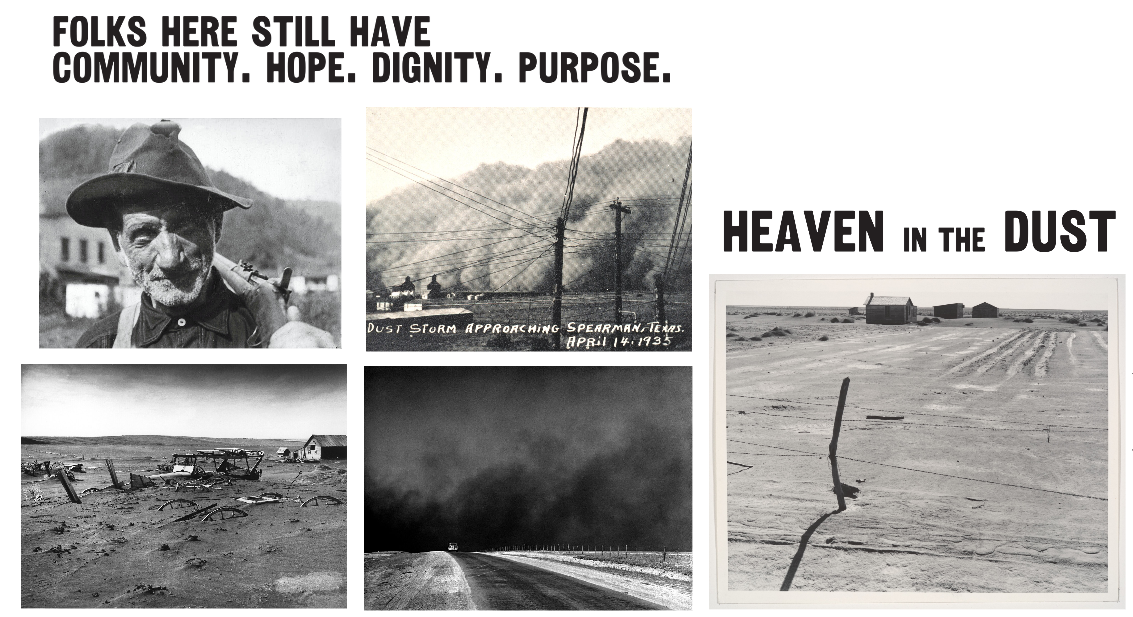
(Header image is a collage of suffering during the dust bowl prepared for our session by Hat!)
Prologue
Dust,
Where a civilisation
Flourished.
[…]
You proud ones, proud of the skill
With which you play this game—Civilization;
Do not forget that it is a very old game.
[…]
There is a circle around China
Where once a wall stood.
Carthage is a heap of ashes.
And Rome knew the pomp and glory
You know now.
Waring Cuney, ‘Dust’ (1927).
Parodos
Heaven in the Dust is a game of Greek Tragedy. Pure juxtaposition that takes the Greek pantheon with all their power and glory and shoves them into the dirt and grime of a Dust Bowl that never ended. Gods brought down to their knees by the American Great Depression. Tragic.
The discerning among you may be thinking, “Isn’t that just the story of the critically acclaimed Hadestown by Anaïs Mitchell?” Correct. Designer Luke Jordan is upfront that this game is in direct conversation with the musical, but it is not simply a retelling. It is a story engine that, once it has been primed and stoked, will drag your godlings to their cruel fates in a matter of hours. It is a capital D drama machine.
Episode
Each player chooses the playbook of a Greek God, a cast you would be familiar with: Hermes, Aphrodite, Hestia, Apollo, and of course, Hades. Each god has their own domain, a piece of your miserable little town they lord over. Dionysus with her bar, Persephone with her garden, Hephaestus with their camp of striking workers. Their own little world built out of Blair Mountain, Middle America,1 built on thematic and evocative visuals, on what blessings the community still has and what threatens them, and the themes of the tragic game they are about to play.
The course of set dressing and character creation happens all together, at the table. It took our group around 2 hours to build the fraying town, to introduce our miserable cast, and to bind them together with the strings of fate, jealousy, and love. I grew concerned as I watched the clock tick down on our session, but the remaining 2 hours were exactly enough time for these Gods to tear each other to shreds.
Stasimon
Consider the place that is and time it was: this is a myth, not history; this is a tragedy, not a retelling; our gods will be grounded, by whispers, by choice, by necessity, by the events of our tale; our gods will be ground by the history, whittling them to a single truth.
Consider who we are and who we are not: call it self-made, cyclical, unrelenting, predictable, freely-chosen, voluntary, preordained, irresistible; the tragedy is of each, god and mortal, and it is inevitable.
Episode
The game uses Belonging outside Belonging to resolve and create conflict, and to push the story forward. Each character has Moves, powerful narrative abilities that require a Coin to play. As Hades, I needed Coins to make an extravagant show of wealth, to starve or beggar others, and especially to show a moment of kindness.
To gain Coins to spend, I could engage in my Failing: putting others in their place or hurting them to keep them safe. Other Gods also tempted me with Coins: Aphrodite had one for anyone who would fall in love with her or break a given promise, Hermes for anyone seeking out his guidance or trust, Dionysus for those seeking release or treating their pain as a joke. The Gods, of course, remain fickle, and cruel: if I dabbled in another God’s domain, they could steer and tempt me with Coin, and suggest a ruinous action instead, something that would surely derail my plans entirely if enacted. Coins are scarce and precious and almost always worth the price.
This push and pull of needing to show weakness or give in to another God’s plan to gain the resources necessary to move your machinations forward is the juice that Heaven in the Dust is selling. Your need for power constrains you to carve the path to your own demise. It is Circe trying to protect Telegonus and killing Odysseus. It is good game design.
Stasimon
Consider who we are, in detail: whenever someone plays into a Lure, you gain a Coin, but Hermes grants one instead; there are no weak moves, only Failings, and Duties broken; there are no powers or settings, but Birthrights with ruinous actions.
Consider what we have and have not, and what most yearn: our currency is not tokens, they are Coins. Of course.
Episode
The most unexpected treasure in the book is the Chorus: a secondary cast of characters made up of battered and broken humans, living among these scheming Gods and able to be drawn into any scene.2 Our story included the widow of a factory worker, a fast-talking conman who had just arrive to scab, and a mysterious wealthy old woman. The old woman enabled Hades to pivot production from automobiles to weapons of war, the cries of the widow started the strikes in earnest, and the conman’s death lit the tinderbox of a town and brought it burning down.
While every table decides how supernatural their Gods truly are – are they just people, larger than life characters as they become protagonists? are they archetypes, playing a role that blurs the miraculous and the mundane? or are they actual Gods, fallen to the Dust for this tale to take place? – these Chorus members act as playthings for the gods. They don’t have moves, no way to fight back, they show up in scenes to be chewed up and spit out by the Gods. What they have is a tragedy that awaits them, to be picked from among a possible six. The Chorus shines a light on the Gods’ inhumanity, elevating the myth. The perfect supporting cast to show just how cruel and hideous Hades is, or the futile hope that Hephaestus might be able to save the town. Our Chorus was turned to satyrs by a reckless, too-in-debt Dionysus, then brutally put down by a militant police force. Tragic.
Stasimon
Consider whose voices haunt the game: Cuney, Johnson, Hughes, Sorley, Sandburg; and Jordan, of course.
Consider whose voices rise from the game: the cruel, the hopeless, the hungry, the lost, the weary, the wicked; and our gods, of course.
Tragedy
Heaven in the Dust might be my perfect game. Those who know me have heard me cry out for more Greek myth inspired RPGs that focus on the heartless beauty of the Gods. Those who know me know I spent my undergraduate years researching bank failures leading up to the Great Depression and have a particular fixation on the Dust Bowl. So it came as a shock to open my November 2025 monthly Zine Club adventure game to find this, a game that was made just for me.
The tragedy in RPGs as a whole seems to be the difficulty of discovery. I fell upon Heaven in the Dust almost by sheer luck. There are a million alternate lives that would never cross paths with this masterpiece. That’s a shame. That means I am missing other games that are perfect for me. How many other Luke Jordans are out there pumping their heart and mind into these works of heart that I will never see.
This discoverability problem exists for most games, but I must say that the biggest flaw of Heaven in the Dust is how just deep the issue goes. This was written by Luke Jordan, but does not appear on their itch page, I assume due to licensing agreements with the publisher, Plus One EXP. Additionally, Luke Jordan’s name, nor the names of the rest of the team – editor Andrew Gillis, the playbook artist Barclay Travis, or the layout designer Johnny Isorena – appear anywhere on the version of the PDF I received from the Zine Club.
I already feel like I have to fight tooth and nail to find the design team for any given game (thank you Drive Thru RPG for being really good for this), but not having them in the PDF at all is wild. Luckily I have the print copy which does add these attributions, but it is a concern for anyone who only bought the digital copy.3
Exodos
I love this game. I want everyone to know about it. Email me at brett@birdmilkcafe.com and I will facilitate it for you. You’ll love it.
Consider, stranger, the arc of each character, chorus and god alike, and how the play concludes: “Every session […] ends the same way. […] set the game and these characters down, for now or for good. Then say your farewells.”
Cast
Heaven in the Dust can be purchased here.
Thank you to Luke Jordan for designing this incredible work of art, along with Andrew Gillis, Barclay Travis, and Johnny Isorena for helping turn the design into a zine of mythic proportions.
Thank you to Xaitza, our Hermes who played the fool but spilled wisdom at every turn; to Hat!, our Dionysus who was brash and reckless and generous and selfish; to Zadig, our Hephaestus who chose their morals over profits and still got their camp of workers caught in the crossfire.
And a very special thank you to Alex V, who wrote the stasima for this review, provided editing above and beyond what I could have asked, and played our Aphrodite, who refused to be used as a pawn by the hubris filled men of the town and disappeared into the cold.
- Determining where exactly your game is located is part of setting the scene, Zadig’s special interest in the history of labor rights and the tragedy of the Battle of Blair Mountain was a special boon to our game. ↩︎
- The Chorus is comparable to the Neighbours from Harvest, the setting elements in Sleepaway, and the Kith in Wanderhome ↩︎
- It is entirely possible the PDF has been corrected since I received my copy, and if not, it deserves to be corrected as soon as possible. Along with the addition of the design and art attributions, the physical copy also corrects some minor mistakes such as missing page references in the chorus creation step. There were still a few minor issues that persisted in the physical edition, and we would have loved to see ellipsis added into the poems that precede each section and playbook when sections of the poetry is excluded. That said, these are nitpicks that I point out only because this book deserves to be perfect. ↩︎
Leave a Reply